
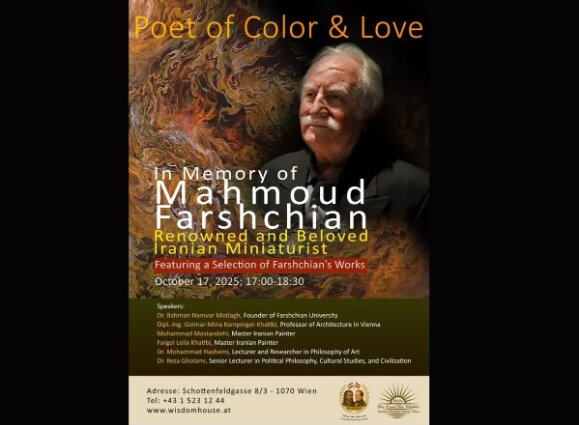
Tehran – The Islamic Republic of Iran’s Cultural Representation Office in Austria, in collaboration with the Hafez Hammer Pulkstor Cultural Association of Austria and the Iranian Wisdom Museum in Vienna, will hold a memorial event for Mahmoud Falsitian, a renowned Iranian painter and master of Persian miniature painting who passed away in August at the age of 95.
According to Irna News, the commemorative ceremony entitled “Poet of Color and Love” will be held on October 17th, with the aim of celebrating Falcien’s artistic achievements and lifelong contributions.
The event will be an opportunity to revisit and appreciate the enduring legacy of Farcian in the arts and culture.
The event will feature a selection of Falsien’s works and will feature a series of specialist lectures on the philosophy of art and Iranian cultural heritage.
Speakers at the ceremony include Bahman Namval Motlag, founder of Falsitian University and professor of architecture at the University of Vienna. Ing. Golmar Mina Kamginger Hatibi, Iranian master painters Mohammad Mustandehi and Falgol Leila Hatibi, lecturer and researcher of art philosophy and senior lecturer at political philosophy, cultural studies and civilization, and executive director of Iranian Wisdom House in Leather Gorami, Vienna.
Born in Isfahan in 1930, Mahmoud Falsitian is known for his exquisite works inspired by Persian literature and religious documents, and is known as one of the most prominent figures in contemporary Iranian art.
Farsician’s work is known for its intricate craftsmanship, combining traditional Persian miniature techniques with innovative elements that breathe new life into classic themes. His art brings to life the souls of Persian poetry, religious stories and spiritual symbols to produce works of visually wonderful and profound meaning. His skilled skills lie in a delicate balance between tradition and innovation, creating vibrant, flowing lines, circular motifs, and dynamic colors that evoke emotions and transcend cultural boundaries.
Throughout his illustrious career, Falcien’s works have traveled the world and been exhibited in renowned cities such as Paris, New York, Chicago and Tokyo. Many of his works were presented by Iranian authorities as symbols of Iran’s rich cultural heritage. His contributions have led him to win numerous awards and reaffirm his status as a national treasure.
Falciens transforms the canvas into a sacred space where sadness and hope are intertwined with intricate details, dynamic compositions, and skillful use of colour and symbolism. These paintings not only preserve Kalbala’s historical memory, but also evoke timeless lessons of faith, justice and resistance to oppression.
Farsian’s influence extended beyond his brush. He served as professor and director at the Faculty of Art, Tehran University, Iran, and formed generations of artists who continue to carry on his artistic vision.
Despite its international reputation, Falsian remained rooted in his Iranian identity. His art, inspired by Persian poetry, the Quran, and scriptures of Christianity and Judaism, created a universal language of spiritual artistry. His ability to combine tradition with modernity has been praised all over the world, and scholars such as Italian art historian Umberto Bardini have described him as “a phenomenon and important point in Iranian art.”
He made a significant contribution to the international promotion of Iranian art and was frequently invited to speak at universities and cultural institutions around the world. Several books and academic papers on his work have been published, and his legacy as a master artist is solidified.
His name is on the UK’s list of 2000 outstanding intellectuals of the 21st century, and collectors are extremely honored to own his work.
Falsitian was one of 40 Iranian artists to be recognized by the Iranian National Library and Archives to celebrate outstanding works he has created over the past century about the tragedy of Asura.
Founded and led by Hassan Javaheli, the Hafez and Hammer Pargustall Cultural Associations are intellectual, philosophical, scientific and cultural networks without borders. This study was formed with the support of European (particularly Austrian) scientists, thinkers and cultural figures, as well as the cooperation of Iranian scholars living in Austria.
The association’s mission is to promote dialogue, critical consideration and cooperation in the fields of philosophy, Iranian studies, and Persian and literature, as well as to promote strengthening Iranian and Austrian cultural relations.
The Association is currently operated through several key departments specializing in specific areas of intellectual, cultural, arts, or literary activities. Among them, the Iranian House of Wisdom in Vienna stands out as a leading division of philosophical and scientific efforts.
The director is Leza Gorami, a senior lecturer in political philosophy, culture and civilization studies and a faculty member of the Institute for Humanities and Culture Studies in Tehran. Under his guidance, Iran Wisdom House became a hub for academic discussion and philosophical dialogue, with many of its events being held in English and accessible online to audiences from around the world.
The Association’s other cultural, arts and literary activities are organized through its additional sectors, contributing to its broad mission of deepening cultural understanding and preserving humanistic values around the world.
The association’s events take place at various venues, such as universities, cultural centres, libraries and cafes, and are often held at the Avicenna Hall of the Iranian Cultural Delegation in Austria, providing spiritual and financial support.
Unbound by ideology or political affiliation, Hafez and the Hammer-Pulgustoll Cultural Association operate on wisdom, rationality, equity and ethics, with a strong resolve to respect Austrian law and values.
SS/SAB