
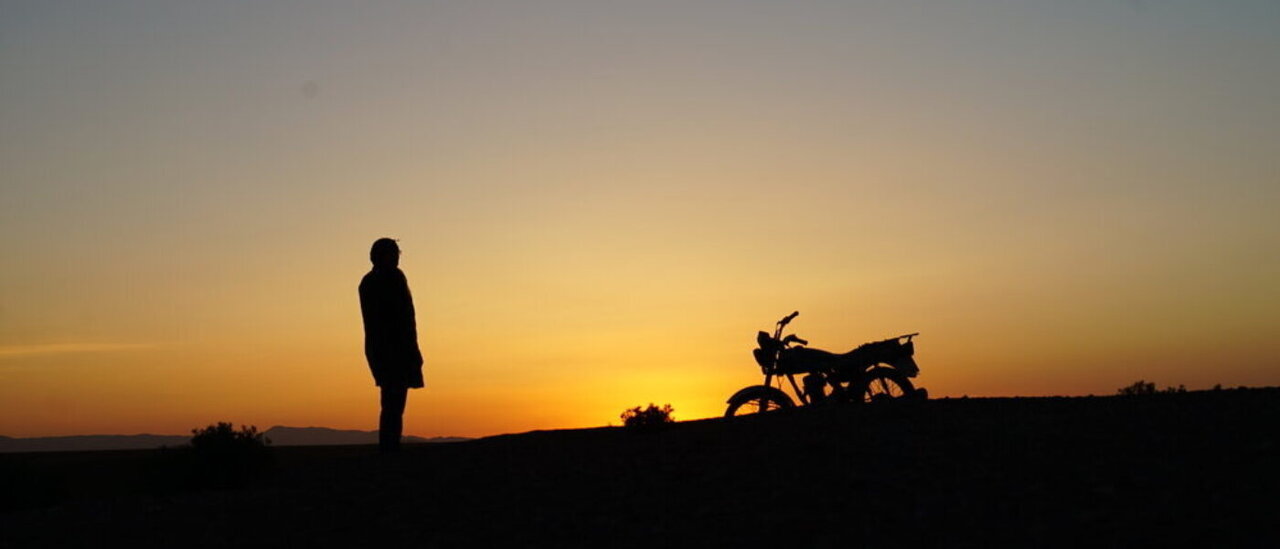
TEHRAN – The Iranian documentary “Cutting Through Rocks” by Sara Karki and Mohammadreza Eini won two awards at the 41st Warsaw Film Festival, held in Poland from October 10 to 19.
The Polish festival awarded the documentary with the NETPAC Award, honoring it as a powerful testimony to the unyielding perseverance of a woman standing up in an oppressive atmosphere.
According to a report from ISNA, “Cutting Through Rocks” also won the Audience Award in the FREE SPIRIT category at the festival.
The documentary tells the story of Sarah Charbeldi, the village’s first elected city councilor, who aims to break with long-standing patriarchal traditions by training teenage girls to ride motorcycles and stopping child marriage. Sarah’s identity is thrown into turmoil as accusations arise that question Sarah’s intentions to empower girls.
The 95-minute film, co-produced by Iran, Germany, the United States, Qatar, the Netherlands, Chile, and Canada, won the World Cinema Documentary Award at the Sundance Film Festival World Cinema Documentary Competition in the United States, and the Griffon Award at the 55th Gifoni Film Festival in Italy earlier this year.
In “Cutting Through Rocks,” the directors deliver a deeply intimate and quietly defiant portrait of resistance and resilience. Their debut feature documentary follows Sarah Charveldi as she seeks to empower young women to imagine a future of freedom, education, and autonomy.
At the center of the film is Charveldi herself, a remarkable pioneer who drives down dusty village roads, teaches teenage girls how to ride motorcycles, and campaigns against the still-pervasive practice of child marriage. Handheld and unadorned, the camera is close to her, never intruding, but ever alert to the emotional and political weight of her daily struggles. This raw, observational approach gives the film a quiet power and cumulative tension.
Sarah’s charisma and sheer force of will propel the story forward. Her vision becomes a beacon of hope in a stifling social climate as she inspires girls to stay in school, dream of careers in medicine, education, and engineering, and take control of their lives. However, her journey has not been a smooth one. Suspicion and resentment surround her. When suspicions arise about Sarah’s intentions with the girls she mentors, Sarah’s own identity comes under scrutiny and ultimately attack.
The score, used sparingly and sensitively, accentuates the emotional arc rather than overpowering it. The raw, organic cinematography resists romanticization, reflecting the raw terrain and the social tensions within it. “Cutting Through Rocks” begins with a quiet observation, but builds into an emotional crescendo, culminating in a series of painful defeats and existential questions.
This movie does not offer an ending or a simple hope, but there is a hidden sincerity in it. This is not a story of triumphant change, but of the necessary resistance in the face of insurmountable odds. Ultimately, this documentary is as much a sobering reminder as it is a testament to personal courage.
Founded in 1985, the Warsaw Film Festival joined the elite group recognized as an international film festival by the International Federation of Film Producers Associations in 2009.
For more than 40 years, the Warsaw Film Festival has promoted films that bring people together, provoke thought and leave lasting impressions. This is a space for creative freedom, dialogue, films that tackle important questions, and a place where the stories that really matter come together.
In the previous edition, two Iranian films won the festival’s top prize, the Warsaw Grand Prix. In 2004, Asghar Farhadi’s The Beautiful City won the award, followed by Parviz Shahbazi’s Malaria in 2016.
SS/SAB