
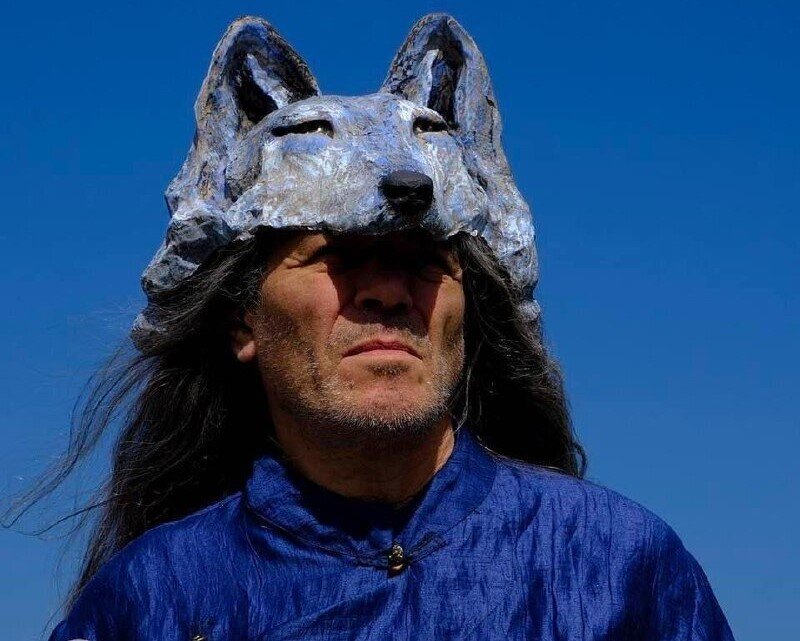
TEHRAN – This exclusive Tehran Times article introduces the voice of Anthony Heke, a French-American poet, composer, singer and multidisciplinary thinker. His work combines music, mythology, trauma, and moral reflection with deep cultural critique. Born to a French father and an American mother of Lithuanian Jewish descent, Heke grew up with a haunting legacy of World War II in his family: a grandfather who fled anti-Semitic terror, an uncle who parachuted into France with the 101st Airborne on D-Day, and a father who survived the Nazi Mauthausen concentration camp. These intimate stories of resistance shaped his lifelong dedication to confronting oppression and fostering empathy rather than indifference.
Today, Heke’s artistic landscape is vast. He has created transmedia operas such as “The Saga of Blue Wolf,” immersive installations under the banner of the Gyre Project, and works such as “Shadow Work” and “Ancestral Echoes.” These works, rooted in blues, soul, and ritual performance, challenge cultural erasure and restore the spiritual survival of marginalized peoples. He argues that art is civilized, not decorative. Memories are encoded in sounds, images, and stories that embody resilience.
Heke’s recent essay, “The Global Spiritual Crisis and the Call for Empathy,” brings us his creative and intellectual journey on the Gaza conflict, mapping generational suffering, silence, and propaganda. It demands moral clarity, collective courage, and a rebirth of imagination to reject negative hope and reverse the collapse of empathy.
In our interview, Heke invites us to explore how trauma is transmitted, how music embodies resistance, and how a lack of empathy marks a turning point in civilization. Join us as he challenges organizations and individuals to listen, feel, and act.
The text of the interview is below.
Why did you choose to focus on Gaza/Palestine in your recent work? What is the personal, philosophical and moral journey that led you there?
I’m French because of my father, and American because of my mother. My mother’s parents were Jews who immigrated to America from Lithuania. My grandfather deserted the Red Army and fled to America. He lived and worked in the United States for several years before bringing his wife and children here. During that time, some members were burned alive in the synagogue by the Nazis.
When his son, my uncle, turned 17, he enlisted in the 101st Airborne, also known as the Screaming Eagles. He parachuted into France to kill Nazi officers on D-Day and several times thereafter. He performed the mission as a lone sniper.
My father was in the French Resistance during World War II. He committed sabotage at a railroad depot, was photographed during the act, and was later captured by the Nazis. They sent him to Mauthausen concentration camp. He was only 20 years old at the time. He survived because older political prisoners organized an internal resistance network and planned his escape. They took him under their protection.
These three very brave men set an example for me to follow. I grew up listening to their stories, and when I was old enough to understand what they had to endure to fight oppression, I understood the true meaning and value of courage.
Currently, America and Israel, with the support of France and most of Europe, are the oppressors of the Palestinian people. I cannot be an accomplice to the violence and brutality that is being committed in my name. The first time as a Jew, the second time as an American, and the third time as a Frenchman.
What sources, testimonies, and research have shaped your understanding of the suffering and trauma in Gaza? Do you have any first-hand accounts?
I have never had direct contact with people living in Gaza. My understanding of suffering and trauma began long ago from another source. A close friend was posted to Jerusalem, and his job for many years was to oversee the expansion of the West Bank barrier. He then quit his job at an NGO and founded a film production company that produced films about the expansion of the West Bank barrier, its abuses of Palestinians, and the legal battles brought to the International Court of Justice. The most shocking fact for me was Israel’s complete disregard for international law, the unconditional support of the United States in this regard, and ultimately the absence of real international law.
Due to the complete lack of this law, the Palestinian people are forced to suffer oppression and humiliation day after day, year after year.
You advocate empathy as more than an emotion, as a political and spiritual act. How do you think that applies to the situation in Gaza, where many voices are silenced or distorted?
As humans, we are complex beings, the result of millions of years of evolution. Our most primitive core is housed in the reptilian brain and is thought to be responsible for survival functions. The limbic brain is associated with emotional regulation and social functioning. The neocortex is where we process information and is the source of language, cognition, and reasoning. Propaganda uses fear and greed to coax the primitive brain into a survival mode that avoids regulation and reasoning. Political and spiritual development is a process of voluntary self-regulation in which empathy and reasoning balance impulsive behavior. Too many Israelis, too many Jews, and people in the West still instinctively react as if they were under attack. This inversion is a distortion of reality, the result of a weakened soul refusing painful introspection and projecting its own darkness onto others who are temporarily under its control.
What does it mean to seek truth in the context of Gaza, where there are conflicting narratives, propaganda, censorship, and suppressed voices?
Truth is not sought, but revealed. The global Western media is doing everything in its power to paint a favorable narrative for Israel. At the same time, censorship and repression are at work, with people being arrested for voicing their opinions in the UK, and professors using their tenures in the US to get journalists shot or forced to quit their jobs… But the psychopaths orchestrating this disinformation are pushing the limits. In today’s world, truth cannot be suppressed. The internet is full of videos that clearly show the atrocities being committed by the IDF and the most brutal Israeli settlers. Israeli soldiers document their atrocities and visibly rejoice in them. Psychopathy creates its own demise. Justifications like “Israel has the right to defend itself” are starting to sound increasingly pathetic.
Art is a recurring theme in Gaza reporting: destroyed galleries, artists using aid, and the recovery of identity. What role does culture (poetry, art, music) play in healing, resistance, and preserving memory?
As an American blues and soul singer, I can best answer this question. To talk about the role music played in Black Americans’ resistance to slavery and oppression. It is still difficult to imagine a world where male slave owners raped young female slaves, produced children, and sold them into slavery. We are our own descendants. In the face of this barbaric brutality, black culture not only survived, but thrived. Wealthy white slave owners in America did their best to destroy the culture of black slaves and instinctively banned musical instruments. But nothing could prevent those working on farms or in chain gangs from singing. Then they made the big mistake of allowing themselves to meet at Congo Square in New Orleans on Sunday. From here, the marching band that became the beginning of jazz was born. Today, American jazz, blues, and soul music has become “American music” and is known and adopted around the world. This music gave black people the resilience they needed to survive and later thrive. One fact that is almost completely ignored is that American Indians, and to some extent poor whites such as the “white trash” of the Appalachians, also contributed significantly to the elaboration of these musical genres that later mutated into rock and roll.
You link the loss of empathy to the world’s silence on the situation in Palestine. Do you think this is a symptom of a deeper psychological or civilizational collapse?
Civilization is based on the ability of individuals to extend their circle of care and empathy from themselves to their families, communities, their countries, and the world. It is this expansion that gives humanity power. Civilization is based on creativity, on the power of poetic words. There are currently attempts to take over and destroy this power, carried out by a small number of psychopaths. Their deep-seated fears and greed require endless wealth and power to compensate for their lack of connection with other humans.
This mental imbalance is also promoted in the rest of humanity, such as “greed is good”, “be yourself”, domination and conquest, rape and pillage and plunder.
As long as this kind of awareness of “success in life” remains widespread, we will never have peace.
You mention “intergenerational trauma” that shapes the behavior of both victims and perpetrators. How does this concept help us understand the ongoing violence in Gaza?
Europe’s Jews suffered immense trauma at the hands of the Nazis, but so did Poles, Russians, and active minorities of French and other Europeans. Jews were not the only victims of the Holocaust. The Romani Holocaust also occurred around the same time, but has received less attention. We Jews were able to take advantage of this disaster because we were a wise people. Laws were enacted, vocabularies were created, movements were born, and reparations were demanded and made.
A strange twist of fate prevented much needed introspection and healing.
Now, the trauma suffered by Jews is being projected onto Palestinians who have nothing to do with it. The most pathetic part of this story is that Palestine was once a territory where people of different cultures and faiths coexisted in peace and prosperity for centuries…This transfer of trauma is not only cruel and foolish, it also leads to Israel’s possible self-destruction and creates the threat of global conflict.
Do you see any signs of movement or awakening among artists, mental health professionals, or the general public that give you hope in the face of situations like the one you describe?
Voices are emerging to bring truth and clarity to the global conversation. Several very prominent and well-spoken former U.S. military personnel are speaking out. What is interesting is that they not only criticize the foolishness and irresponsibility of the belligerent attitude adopted by current leaders, but also criticize the false values of America, Europe, and the Global West.
Psychologists and neuroscientists are also trying to connect the dots between the collapse of society, the deterioration of our values, and the functioning of the human mind.
Economists question the premise of capitalism, its eternal growth, and its inevitable consequences: stealing resources and land, enslaving and destroying people, and the very source of life.
With support from the United States and Europe, a growing number of people are speaking out against Israel’s actions. Peaceful protests are a good sign, but it’s enough to change the outcome.
The point is, I don’t believe in hope…I believe in courage, I believe in speaking clearly, I believe in decisive action in the face of madness and oppression.
By the way, what’s going on with poets and artists? What are we doing? As poets, we’re not doing our best to provide social commentary. What the world lacks most is not insight but imagination. We’re stuck because simply explaining why things fail doesn’t inspire action. The ability to create a vision and arouse the desire to realize that vision…Poetry and music are more than the language of the soul, they nourish it, but our collective soul is starving to death.