
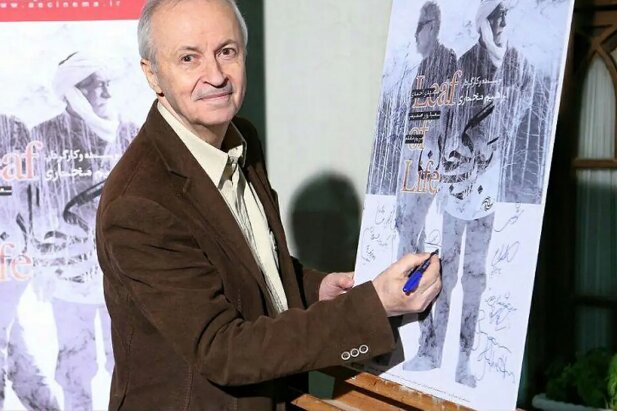
TEHRAN – Iranian film director Ebrahim Mokhtari will head the international jury for the 4th New Persian Image Festival, which will screen a number of Iranian films.
According to a report in ISNA, director Mokhtari, whose 1994 film ‘Zinat’ will be screened in the Out of Competition category, will also receive the Golden Misra Award from the film festival, which will be held in Vitre, France from November 5th to 11th.
Written and directed by Mokhtari, “Jinaat” is a portrait of a courageous woman caught between tradition and modernity in a changing society.
In the film, a young woman named Zinat, who works at a rural health center in Iran, is about to get married. Her fiancé Hamed’s family did not want her to continue working after the wedding, and all efforts to convince him that Zinat’s work would not affect her family life were in vain. Zinat’s family is also against it, fearing that she will anger Hamed’s family.
Finally, Zinat agrees to quit her job. She gets married and throws herself into family life. The problem seems to be resolved. But beneath the calm surface, conflict is creeping into Zinat’s relationship with her husband.
One day a woman brought her sick child in for treatment. Despite her husband’s objections, Zinat decides to save her child and takes her to the city for treatment.
Ebrahim Mokhtari (78), born in Babol, Mazandaran province, is a graduate of Tehran University of Film and Television, majoring in film production. He started his film career on Iranian television, initially participating in two series as an assistant director.
Mokhtari then began making documentaries for Iranian television, establishing himself as one of the country’s prominent documentary filmmakers.
He made his first feature film Zinat in 1994, which was screened at Cannes Critics’ Week in 1994 and was a success. The Leipzig Film Festival held a tribute to Ebrahim Mokhtari in 1997, and the Tehran Rural Arts and Literature Festival awarded him a special award for his film career in 1999.
“Mokarame, Memories and Dreams” (1999) and “Leaf of Life” (2017) are among his other notable films.
He was one of the members of the founding board of the Iranian Documentary Film Producers Association and served as its chairman for the first three years.
In addition to Mokhtari’s “Zinat,” 10 films by Iranian filmmakers will be screened in various sections at this year’s New Persian Image Festival.
The fourth edition of the competition features four feature-length fiction films competing for either the International Jury Prize or the Audience Award.
All films are new or recent and will be programmed as French or world premieres during the festival. These include “Asteroid” written and directed by Mehdi Hosseinivan Aaripour, “Scary” by Behnam Behzadi, “Locusts” by Faeze Azizkhani, and “The Wind That Shakes the Sugarcane” by Ebrahim Ashrafpour.
“Asteroid” depicts Ebrahim, a 12-year-old boy who lives with his mother and five siblings of all ages in a two-room hut in the heart of the desert, far from the village. Besides feeding their children and obtaining birth certificates, Ebrahim and his mother’s main concern is building a house in the village to avoid the long journey back and forth on foot.
“I’m Scared” is about a poet named Bahman who lives in the chaotic city of Tehran. Lately, he has faced a series of life challenges. We are losing ownership of the store. And he is always being chased by a motorbike.
Overwhelmed by this situation, he was unable to write poetry and became increasingly isolated and frightened. In a society where the rich and powerful set the rules, Buffman must either find the courage to fight injustice or accept humiliation and lose everything.
In “The Locust”, Hanye is a bankrupt woman in her 40s who is being evicted from her apartment by her landlord. She has been trying for years to make a film based on her semi-autobiographical screenplay. Accepting that her dreams will never come true, she has no choice but to sell the script to one of her best friends who can direct it.
Hanye, who is deeply attached to his work, does not tolerate any indifferent or ignorant reactions during the pre-production stage, but he is determined not to get involved in conflicts with directors, actors or staff. But things start to get out of control.
“The Wind That Shakes the Sugarcane” depicts a scene in which Younes’ father is arrested after being accused by a sugar factory owner of setting fire to a sugarcane field. Eleven-year-old Younes learns that on the night of the accident, his father, a prominent figure in strikes and demonstrations, was attending a meeting with other workers to discuss their demands.
He then attempts to bring the witness to court. This is the starting point of his journey. He wanted to forget his passion for soccer and ease the burden on his family.
The short film selection includes three films. After voting, high school and university students will award the Arts, Culture and Education Award to the winners.
Out of Tune by Vahid Mazrae, Vermin by Tina Dehghan and When, Where, Who, Why by Roozbeh Hesari are Iranian films in the short film category.
In “Out of Tune,” a man makes a living by whistling songs to passersby on the street. But one of his customers makes another request, posing an unexpected challenge to him.
“Vermin” follows a young weaver who moves into a carpet-weaving workshop and struggles to overcome his fear of contact. Soon, she becomes infatuated with her neighbor, a handsome and outgoing musician.
In “When, Where, Who, Why” a young artist plans to travel to Europe to attend a painting exhibition. She wants to showcase her work and accompany her best friend, Avan, who will be her lifelong partner. However, she finds that her father has refused her permission to leave the country.
In the documentary category, three documentaries by Iranian filmmakers will be screened, including “Spring” by Nahid Rezaee, “Eastwood” by Alireza Rasoulinejad, and “Walk with Your Soul in Your Hand” by Sepideh Farsi.
In “Spring,” the filmmakers document the establishment of a children’s library in the remote village of Baluchestan in southeastern Iran, 1,800 kilometers from Tehran. Through this project, she will introduce village boys and girls to story writing and short film production inspired by local culture.
“Eastwood” is the story of an amateur filmmaker who sees a photo in a newspaper and heads to southern Iran to find someone who resembles Clint Eastwood.
“Walk with your soul in your hands” is the filmmaker’s response to the ongoing genocide of Palestinians. She met Fatima Hassouna, who became her eyes in Gaza, where she fought back by documenting the war, and Persian became her connection to the rest of the world. Hassouna was assassinated on April 16, 2025, in an Israeli attack on her home.
Established in 2019, the New Persian Image Festival aims to introduce Iranian culture to a wider audience through film, literature and music.
Photo: Ebrahim Mokhtari at the premiere of his second feature film “Leaf of Life” at the Iranian Cinema Museum in Tehran in 2017.
SS/SAB