
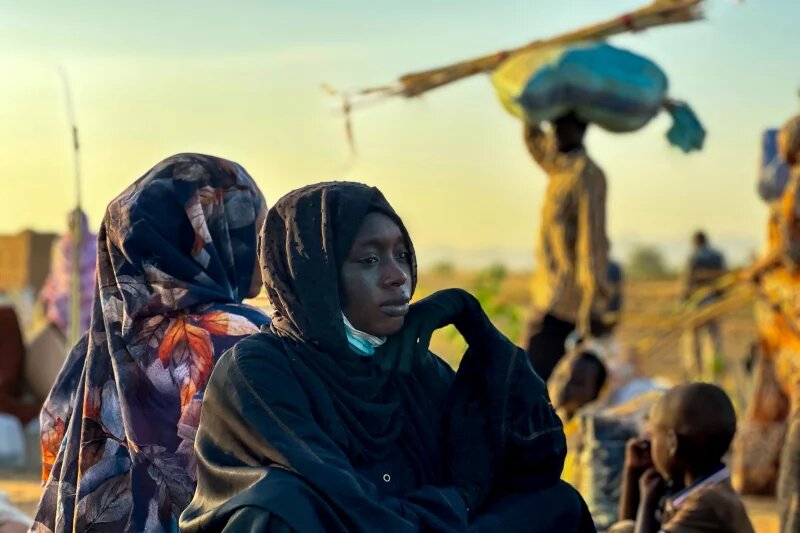
Twenty years after vowing “never again,” the same villages are burning, the same people are fleeing, and the same perpetrators are being released. Inaction is not neutral. It is the ultimate weapon of genocide.
I. Introduction: The return of old wars
Twenty years ago, the name Darfur became synonymous with genocide. Images of burnt villages, mass graves, and endless numbers of displaced families shocked the world’s conscience. World leaders have vowed that such horrors will never happen again.
Today, that oath is in tatters. Darfur flares up again. The same communities are hunted, the same villages are reduced to ashes, and the same patterns of mass murder and forced displacement unfold, often at the hands of the very actors who committed the original crimes, or their successors.
The war that flares up again in 2023 is not a new conflict. It was a continuation of an unfinished crime, carried out with new ferocity under the watchful eye of an international system that mistakes inaction for neutrality and silence for diplomacy.
II. Geography and geopolitics: The structure of the powder keg
Darfur is a vast region in western Sudan that, at 493,000 square kilometers, is larger than the United Kingdom and about the same size as France. It is home to a rich mosaic of approximately 80 tribes and ethnic groups, divided into nomadic and sedentary societies.
Bordering Chad, Libya and the Central African Republic, it sits at a volatile crossroads, where instability in its neighbors seeps across porous borders.
This location makes Darfur a strategic fault line not only in the Sudan crisis but also in Africa’s security landscape. It serves as a corridor for arms smuggling, illegal trade, and irregular migration from the Sahel to the Mediterranean. Beneath its soil are untapped reserves of gold, uranium, and potentially vast oil fields, making this land both a prize and a battlefield.
Approximately 8 million people live in the five states of North, South, East, West and Central Darfur. For decades, they have been caught between resource wealth that attracts exploitation and political centers that have long ignored regional development and security.
III. ICC warning: history repeats itself
In 2023, the International Criminal Court (ICC) reopened its investigation into atrocities in Darfur. ICC Prosecutor Karim Khan addressed the United Nations Security Council (UNSC) and described the “same pattern of crimes” that brought the case to court for the first time two decades ago: targeted killings, weaponization of hunger, and systematic sexual violence.
Khan spoke of a “tragic continuation” – a new generation living the same horrors their parents endured – and warned that if long-ignored arrest warrants are not enforced, the cycle of impunity will continue to destabilize Darfur and spread suffering throughout the region.
IV. Political unity and the role of the Juba Peace Agreement
More than two years after Sudan’s war with the Rapid Support Forces (RSF) militia began, the National Front remains determined to defeat the rebels and restore stability. Signatories to the 2020 Juba Peace Agreement (JPA), including the Sudan Liberation Movement (SLM), have stressed that full implementation of the agreement is not a secondary concern, but a strategic necessity for lasting peace.
In an interview with Brown Land News, SLM advisor Dr. Hussein Aluko Minnawi, brother of Sudanese Liberation Army leader and Darfur Governor Minni Aluko Minnawi, stressed that the agreement’s protocols address both Sudan’s broader national crisis and Darfur’s specific grievances. namely, the return of displaced persons and refugees, the resolution of land disputes (hawaqel: the traditional land rights of indigenous communities in Darfur, recognized and protected on the basis of historical custom, and inseparable from their identity, livelihoods and political legitimacy), and the integration of ex-combatants into national armed forces under agreed security agreements in line with the Disarmament, Demobilization and Reintegration (DDR) Protocol. Disputes over ‘howakers’ have long been a flashpoint in the Darfur conflict, with attempts to redistribute or occupy these ancestral lands often sparking fierce resistance and deepening ethnic tensions.
Fulfilling these commitments, he argued, would complete the SLM’s transition to a civilian party and solidify the JPA as the basis for both reconciliation and the broader war effort against the RSF.
V. Roots of the catastrophe
It was decades before Darfur descended into war. By the early 2000s, political neglect, economic marginalization, and ethnic discrimination brought discontent to a breaking point. In 2003, SLM and the Justice and Equality Movement (JEM) rose up against the Khartoum government, demanding development and an end to discrimination.
Bashir’s regime responded with overwhelming violence, unleashing Janjaweed militias and carrying out terrorist operations. Between 2003 and 2016, hundreds of thousands of people were killed and millions displaced, trapping the region in a cycle of mass atrocities. International outrage led to peace talks and a joint UN-African Union peacekeeping mission, but no lasting solution emerged. Darfur remained militarized, impoverished, and poised for new conflicts.
VI. The Legacy of the Janjaweed and the Crimes of the RSF
Human Rights Watch’s September 9, 2015 report, Men Without Mercy, documented a catalog of abuses by the RSF, the successor to the Janjaweed militia. Crimes included the forced eviction of entire communities, torture, extrajudicial executions, gang rape, and the destruction of vital infrastructure such as wells and food stores. Families’ collective wealth, especially their livestock, was plundered and their livelihoods destroyed in one of the harshest environments on earth.
The report, based on testimonies from 151 survivors who fled to Chad and South Sudan, details civilians killed for refusing to leave their homes, surrender their livestock or forgive the rape of their families. Another 21 witnesses from Kuro and surrounding villages testified that widespread murders, sexual violence, assaults and looting were all part of an organized terrorist campaign.
Human Rights Watch called on the Security Council, the African Union Peace and Security Council, and UNAMID to take decisive action, including holding perpetrators accountable, expanding humanitarian access, providing medical and psychological care for survivors, and fully cooperating with the ICC to prosecute those responsible for serious international crimes.
VII. New Frontiers: Demographic Engineering as a Weapon of War
More than two decades later, the same pattern of violence continues, but with darker strategic objectives. RSF is currently accused of engaging in deliberate demographic manipulation and ethnic cleansing. Dr. Hussein Alko Minnawi said the militia’s long-term plan envisions resettling Arab tribes scattered across the Sahel, from Mauritania, Mali, Niger, Chad, Libya, Nigeria and Cameroon, to the ancestral lands of Darfur’s indigenous communities.
He points out that many of these tribes owe their allegiance to transnational ethnic identities rather than to the states in which they reside. This strategy targets “howakers” directly. By seizing these lands and reallocating them to outsiders, RSF militias will physically erase communities and dismantle the very foundations of Darfur’s social and territorial order.
Dr. Hussein Minnawi warns that such a transformation, carried out through genocide and forced displacement, would irreversibly alter Darfur’s demographic and cultural landscape, ensuring that the region’s original inhabitants are not only dispossessed but permanently replaced.
governor’s warning
Darfur Governor General Minni Arko Minnawi said the RSF militia, supported by generous support from certain foreign countries and reinforced by mercenaries from more than a dozen countries, is a flagrant violation of international law and a direct attack on Sudan’s sovereignty.
In a statement published on his official Facebook page on August 8, 2025, Minawi accused the militias of carrying out a suffocating siege on El Fasher, torching the Zamzam camp for displaced people, and committing heinous crimes against defenseless civilians.
The prime minister vowed that the “exceptional situation will not last long” and expressed determination to free the besieged, restore national dignity and repair the torn fabric of Darfur’s society. Minnawi renewed his pledge to the people and vowed to continue the struggle until victory is assured. Pride is the exclusive property of this noble nation, and treachery and intrigue will end in defeat.
VIII. After the revolution: unrestrained violence
Omar al-Bashir’s ouster in 2019 was hailed as the beginning of a new political era. However, the RSF remained intact and was a parallel force beyond full civilian or military control.
During the brutal dispersal of the Khartoum sit-in on June 3, 2019, RSF fighters massacred more than 100 people, injured more than 700 and committed at least 70 rapes, according to medical testimony reported by the Guardian newspaper. This operation had the characteristics of a force operating with complete impunity.
Fast forward to April 2023. RSF violence escalated to industrial scale. The attacks in El Geneina and El Fasher brought civilian casualties to levels higher than even the worst years of the early 2000s.
Since the outbreak of the Darfur conflict in 2003, the number of deaths has increased relentlessly, accompanied by a huge wave of displacement. Under the Nationalist Congress government, international organizations estimate that more than 300,000 people were killed, a grim standard in the history of atrocities. However, since April 2023, that number has tripled, or even more, as the RSF deliberately targets civilians not only in Darfur but across Sudan. This is not collateral damage. It is a deliberate and calculated campaign to erase an entire community.
IX. Conclusion: The world’s silence is an accomplice
Darfur’s suffering is not a product of chaos. It is the result of a deliberate strategy, executed with precision, maintained through impunity, and made possible by the reluctance of the international community, i.e. political expediency.
Twenty years after the world vowed never again, massacre sites are once again red with blood, concentration camps are once again overflowing, and perpetrators are moving freely between battlefields and foreign capital.
The lesson is a stark one. Without decisive action to dismantle the RSF’s war effort, enforce long-ignored arrest warrants, and protect civilians on the ground, Darfur will remain an open grave in the human conscience and history will remember today’s silence as complicity.
Editor’s note: A call to conscience
The evidence is overwhelming. The pattern is undeniable. The names and faces of the victims are no longer statistics, but living indictments of our collective failings. The Darfur disaster was not a humanitarian disaster, but a crime in progress, and those with the power to stop it chose hesitation over determination.
Every day of inaction strengthens the perpetrators and deepens the graves of the innocent. Empty statements, staged summits, and carefully worded communiqués are acts of collusion, not diplomacy.
The question for the international community is no longer whether it knows what is happening in Darfur, but whether it is prepared to accept the moral and political costs of allowing Darfur to continue. The cost will not only be measured in Sudanese lives, but also in the credibility of all the institutions that once claimed to stand up to the genocide.
History has already recorded what happens when the world looks away. This time, the record is still being written and so is the verdict.
Author: Mohamed Saad Kamil, Editor-in-Chief, Sabah Al-Makki, Deputy Editor-in-Chief
(Source: Brownland News)