
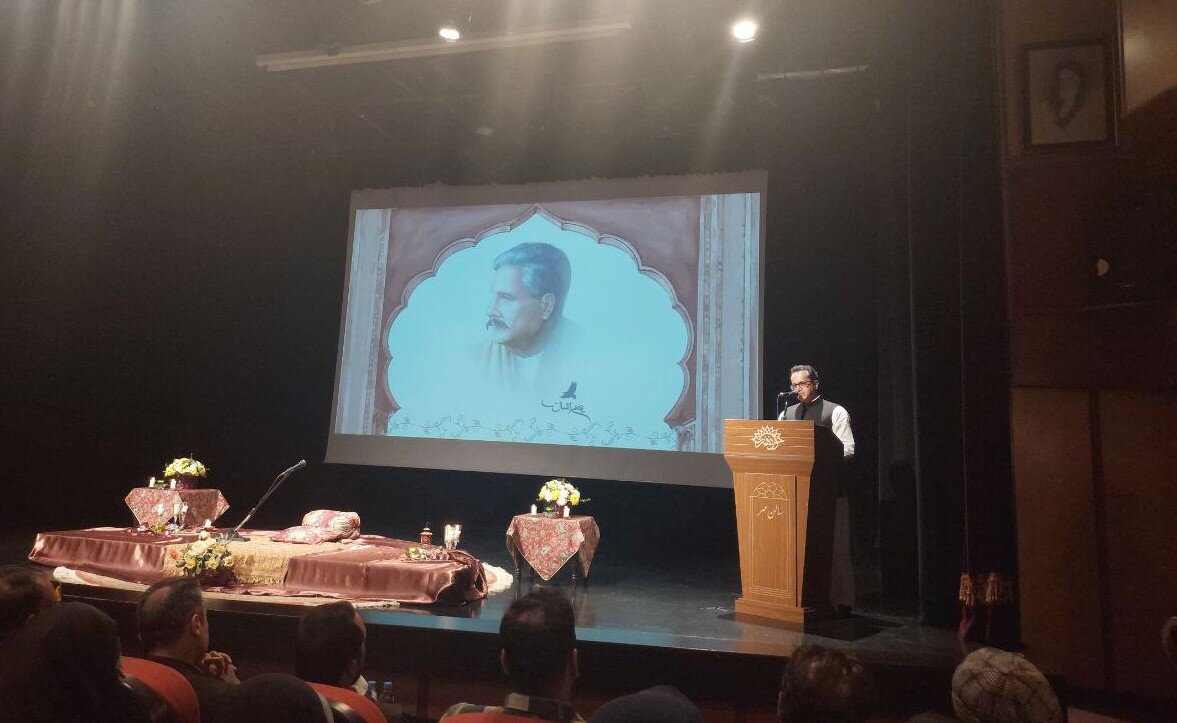
TEHRAN – A memorial ceremony dedicated to eminent poet and philosopher Allama Iqbal Lahori was held at the Arts Department of the Organization for the Promotion of Islamic Thought on Sunday, bringing together eminent poets and literary figures from Pakistan, Iran, Afghanistan and Tajikistan.
The event was held to commemorate Iqbal’s 148th birth anniversary and aimed to celebrate his enduring legacy and promote cultural ties between nations.
The evening featured heartfelt readings and speeches by eminent poets from four countries, highlighting the enduring relevance of Iqbal’s thought and poetry.
The gathering was attended by a diverse audience, including literature lovers, academics, and diplomatic representatives.
During the event, Pakistan’s Ambassador to Iran Muhammad Mudassir Tipu delivered a speech highlighting the importance of Iqbal’s philosophy in promoting mutual understanding and cultural cooperation.
Additionally, renowned Pakistan researcher and Iqbal scholar Zahid Munir Amir delivered an insightful lecture on Iqbal’s intellectual contributions and influence on modern thought.
The event, organized by the Arts Department, served as a vibrant platform for cultural dialogue and reaffirmed the deep bonds of friendship and common heritage between the participating countries. The evening ended with a collective reading of Iqbal’s poems, which left an unforgettable impression on all those present.
Allama Muhammad Iqbal (1877–1938), known as Iqbal Lahori, was a South Asian scholar, poet, barrister, philosopher, and politician, and is considered one of the most important figures in Urdu literature, writing in both Urdu and Persian.
Iqbal is a prominent classical poet in Iran, Pakistan, India, Bangladesh, and Sri Lanka, and is admired by international literary figures.
He is widely known as an Islamic poet or an oriental poet. However, about 60% of Iqbal’s works are written in Persian, making him equally popular in Iran. His poems have been translated into many languages.
Although Iqbal is best known as an eminent poet, he is also highly regarded as a modern Islamic philosophical thinker. He is called the spiritual father of Pakistan.
He was a strong supporter of the political and spiritual revival of Islamic civilization throughout the world, especially in South Asia. A series of lectures he delivered for this purpose was published as The Reconstruction of Religious Thought in Islam.
When Pakistan was founded in 1947, he was chosen as the country’s national poet. He is also known as ‘Hakeem-ul-Ummat’ (Sage of the Ummah) and ‘Mufakkil-e-Pakistan’ (Thinker of Pakistan).
Photo: Pakistan’s Ambassador to Iran Muhammad Mudassir Tipu speaks at the Allama Iqbal Poetry Night held at the Arts Directorate in Tehran on November 9, 2025.
SAB/