
TEHRAN – Osprey V’s story begins not in a studio or on a stage, but in ruins, during power outages, under the sound of drones, and in the shadow of war. As Gaza’s first and only English-speaking internationally recognized rock band, Osprey V is both a witness and a voice for those under siege. Forged through trauma and resilience, their music now transcends borders as an urgent echo from a place the world has rarely heard.
Osprey V is more than just a band. It is a living testimony to destruction, a record of survival, and a voice rising against what members call “a new holocaust.” Their journey dates back to 2003. At the time, young cousins Raj and Momen first imagined forming a rock band in one of the most oppressed and overlooked places on Earth. There were no instruments, no teachers, no stage, no audience in Gaza, and no peace. Still, the dream refused to die.
By 2010, the cousins were teaching themselves guitar online. Joined by a third cousin, Said, they spent their teenage years practicing in a small room above the family’s electronics store, rehearsing amid broken equipment and the distant sounds of bombs, often during power outages.
In 2015 they officially created Osprey V.
meaning of name
Ospreys are ferocious birds of prey, strong, solitary, and methodical inhabiting even the most inhospitable terrain. Its ability to rise from devastation reflects the band’s identity and struggle for survival. The Latin number 5, V, refers to the band’s five original members and symbolizes unity, identity, and rebellion. In the early days, they even hid their faces, allowing their message to be heard louder than their names.
The formation of Osprey V was itself an act of rebellion. Having set up Gaza’s first music store and built more than 100 makeshift studios in a place where amplifiers are the hardest to find, the band led by Raj Al Jal have overcome every conceivable barrier to emerge.
“We had to suffer a lot to make this happen, but we made it happen,” Raji says of the struggle to create music in a land cut off from the rest of the world.
Even the band’s fragile shelter collapsed when Israel’s latest war in Gaza broke out in October.
“Literally, during the war, bombing was going on. We stopped for a second, stopped recording, then paused, and just kept going. We had nowhere to record, so we had to record in the car. Ash was the director of our latest film, ‘Inaudible,’ which shows me in the car trying to capture the silence and record the vocals,” recalls Raji.
music in exile
Raji is currently speaking from Jordan. This refuge has been secured only by the small blessings of international connections and the dedicated advocacy of journalists and activists whose reporting enabled the Jordanian government to “rescue me from the massacre three months ago.”
He is acutely aware of the fate of those left behind in Gaza, including his family and his band’s bassist Momen, and the heavy toll of evacuation.
“You have to do as much as you can within five to 10 minutes. Each time you leave, you have to pay at least 2,000 or 3,000 shekels,” Raji recounted the trauma of departure, loss of possessions, and the experience of moving from “so-called safe places” that often became the scene of new massacres.
Even in the midst of this turmoil, Raj continued to make music. Even when internet access went out for 80 or 90 days, he and his friends hung their phones on ropes to catch the signal and send audio stems to collaborators in Egypt and abroad.
“Music was the only thing that saved my life…Music kept me going and kept me hanging out,” he says. “I remember listening to my music in my car every day, hoping that I would make it out alive and that my voice would be heard.”
Witnesses of genocide, voices of resistance
Osprey V calls itself “the voice of the voiceless.” Their music is both proof and resistance. As Raji says, “We are literally the last musical voice from Gaza…witnesses to this new 2023 Holocaust.”
Each song tells a story. A lost home, a broken dream, an ordinary love interrupted by violence and exile. “Home isn’t a border, it’s not a boundary, it’s every broken dream, every broken heart,” Raji sings, summing up a life of forced migration and yearning.
One song, “Lost and Insecure,” is about lovers in Gaza separated by the necessity of evacuation and the impossibility of return. The other, “Angels Kneel,” was composed before and during the bombardment and questions what it means to cling to humanity in the face of brutality, drawing on Biblical iconography to speak to the universal search for dignity and justice.
“We changed the original lyrics when the genocide started… After the genocide and crimes that were happening in Gaza, these faces will haunt us every day until the day they die because we didn’t give them justice,” Raji explains.
Art as resistance, rock as language
Why rock and why English? For Raji, this choice is clearly political. Rock, he says, is a genre forged in the flames of resistance, a soundtrack to war, alienation, and suffering.
“I’ve never seen a better genre than rock. Even the rock stars and big bands of the past used the same genre when they went through the pain of World War I and World War II,” he recalls.
Opting for English, the band sought to not only reach a global audience, but also to confront Western narratives about Gaza and Palestine. “It was very important for us to be ambassadors for the people of Gaza…We are from Gaza and Gaza is from us. Even if we leave Gaza, Gaza is still among us.”
But their art is under attack. The band claims that the destruction of Gaza’s heritage – the bombing of ancient mosques, churches and the few remaining theaters – is part of a “systematic attack on culture”. Musicians were killed for their art. Their YouTube channel was deleted during the war. When war broke out, performances at the French Institute were canceled.
But every attempt to silence their voices only made their struggle to amplify them even more intense.
Collaboration in the midst of disruption
Osprey V is as much a movement as it is a band, powered by an unconventional collection of artists and activists. Canadian drummer and creative director Ash Moniz, who joined the band during the turmoil, became a vital advocate connecting displaced musicians with resources, instruments, and international collaborators.
For Ash, the act of listening itself became a form of resistance.
“No matter how loud people in Gaza are screaming, people in the West aren’t listening. So I started thinking seriously about what it means to listen. And music offers a different way of hearing. Maybe people hear differently,” Ash says.
His vision for Osprey V is vast. “Every form of life in Gaza is a form of resistance, and art is a very important part of it. Many people I know have spent two years trying not to die. They actually want to live. Art is literally keeping people alive.”
Ash added that the ubiquity of rock makes it an ideal vehicle to convey Osprey V’s urgent message.
“People think of rock as just a Western genre, but it’s actually not. It’s all over the world, and there’s something very vibrant about this genre of music,” he says.
From songs to action
Osprey V aims to not only raise awareness but also encourage practical change. Their music has been used to raise funds for campaigns, and one song, “Drops,” promoted efforts to dig wells in Gaza. They established a way for overseas supporters to donate through small subscriptions, supporting both the band and other exiled artists.
“Music can be an activity on the ground, supporting people financially and emotionally, and a message that can define everything,” Raji asserts.
beyond oblivion
The cost of this trip is devastating. Raji speaks of journalists and artists like Ismail Abu Hattab and Saleh Jafarawi who are killed or disappeared, and the loss of friends and collaborators whose memories fade with a heartbeat. Still, he refuses to remain silent.
“The only terrorist in this region is Israel. The only cancer we have is Israel. This has always been the case. There will never be peace in this region unless we eliminate Israel or Zionism,” he said, refusing to give in to the euphemisms and words of those who tried to erase him.
“I am 100 percent Gazan. My world revolves around Gaza. It always revolves around Gaza.”
He is proud of Gaza’s diversity and recalls how ancient churches and synagogues also stood alongside mosques until they were targeted for destruction.
Osprey V will never abandon Gaza, he says: “Even if we leave Gaza, Gaza is still with us. My family is still in Gaza, my memories are still in Gaza.”
I’m listening, I’m really listening
In his film Inaudible, Osprey V asks the world to not just hear, but listen to the cries of artists, the hopes and despair of a generation of refugees in their homelands.
“Maybe people have heard that scream over and over again for years, but when they hear a song, it moves them in a way they never knew before,” Ash says.
The very existence of the band dares to refuse to disappear.
For those outside Gaza, Osprey V’s music is a call to remember, to bear witness, and to act.
“Hope comes from Gaza,” Ash says. “Among the artists I know around the world, a lot of people wonder what’s the point of making art during a genocide. But when you get to know people who are actually surviving genocide, you realize that art is everything.”
story continues
The Osprey Vs are currently scattered, but not broken. Raji and Ash are in Jordan, while Saeed, the band’s other core member, is in Egypt and Momen remains in Gaza. Their families remain divided by borders, bureaucracy and sieges.
Their stories, like their music, are moving, angry, painful, and fully alive.
They have not forgotten those left behind: the murdered children, the silenced journalists, the erased artists. For every bombed stage, every silenced voice, they respond with song. Sometimes joyful, sometimes desperate, always rooted in an ironclad will to survive and bear witness.
“As long as our voices and the voices of the voiceless are heard somewhere in the world, Gaza is not over. Our story is not over. We are the voices of the voiceless and we will continue to sing,” Raji said.
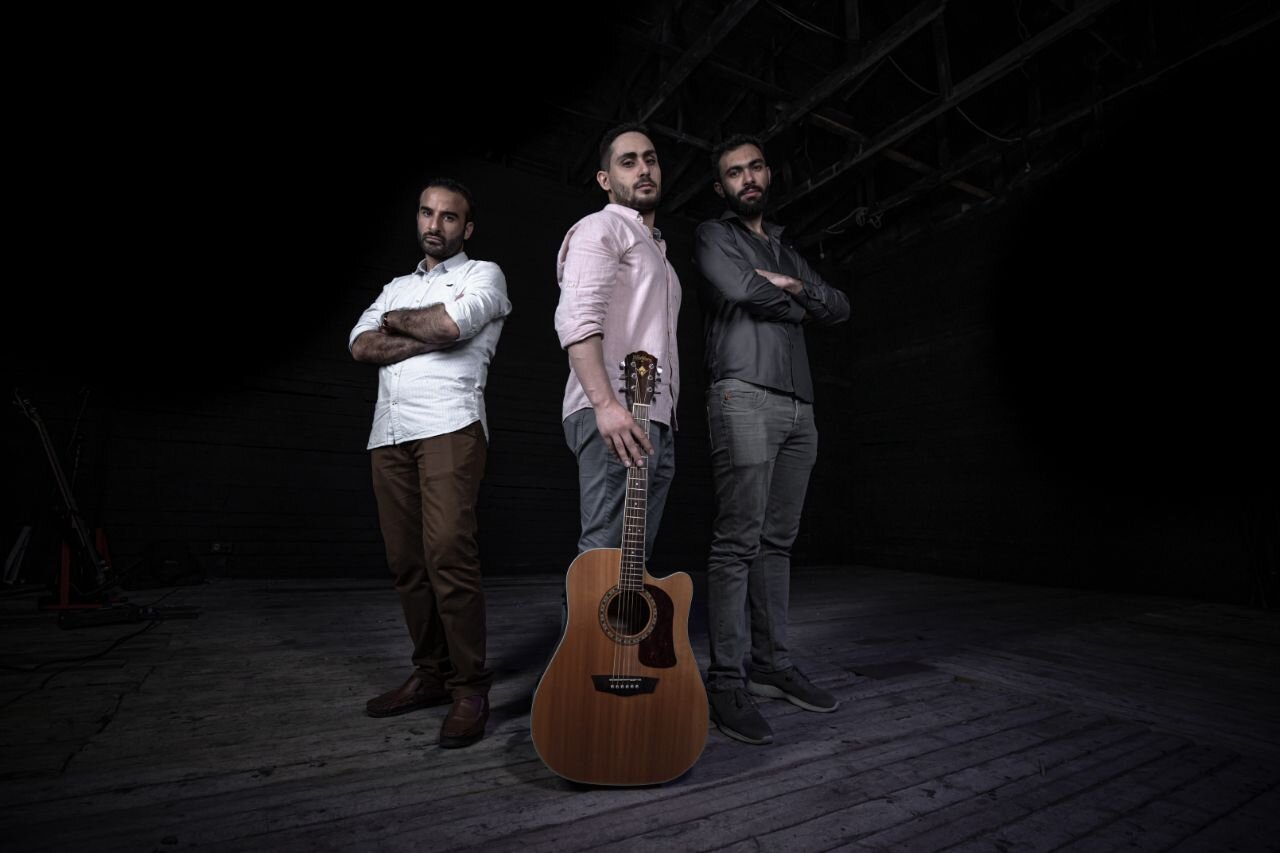
Photo: Left to right: Osprey V Rock Band members Momen Al Jal, Raji Al Jal, Saeed Al Jal.