
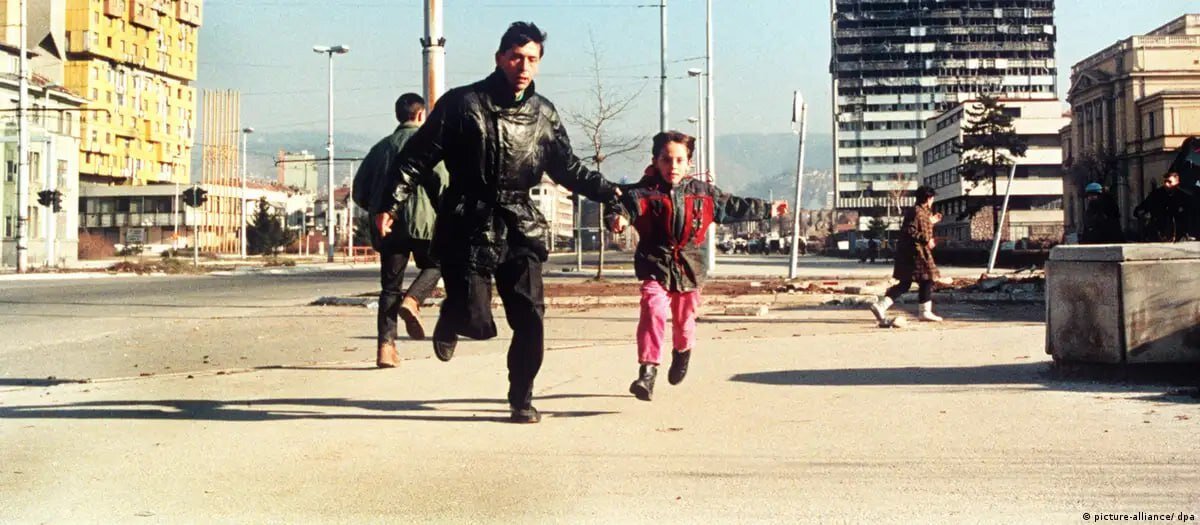
TEHRAN – In an exclusive conversation with Tehran Times, Milan Zupanic, the Slovenian director of the revealing documentary “Sarajevo Safari”, delves into one of the most disturbing and little-known episodes of the Bosnian war. His 2022 film reveals shocking accounts of wealthy foreign “snipers” who were paid to shoot civilians from Bosnian Serb positions during the Sarajevo siege (1992-1996). With painstaking research and courage, Zupanich uncovers the shadowy phenomenon of “human hunting” and explores how brutality, commerce, and war intersected in a city under siege. In this interview, he reflects on his journey from skepticism to guilt, the resistance he faced, and the moral urgency that drove him to expose this unforgettable chapter in modern history.
The text of the interview is below.
What inspired you to make “Sarajevo Safari”? And how did you first learn about the “sniper tourist” phenomenon during the siege of Sarajevo? Was there a particular story, person, or source that convinced you that you needed to make this documentary?
I first heard about Sarajevo Safari in 2019 from producer Francie Zaik. I had already shot a documentary with him in Bosnia and Herzegovina in 1993. He then went to Bosnia and Herzegovina again with a cameraman, and used footage from that time, especially in Sarajevo, for the film. Around that time, Francisco heard various rumors in Bosnia and Herzegovina, and later, without telling me, he investigated on his own. Well, and when he told me about the safari, of course I didn’t believe him by any stretch of the imagination. Franci told me that men were already there at several stages of the safari. So I met this guy, he worked for an agency in America. His mission in Bosnia and Herzegovina was to collect information on the ground, which was how he discovered safari. His stories were convincing and consistent, and I found him to be a professional who observed things truly accurately and reported his testimony so convincingly that it was impossible to ignore. So we started our research.
Do you think this phenomenon was purely opportunistic (war tourism), or did it have an ideological dimension, such as far-right beliefs or the dehumanization of the “other”?
Sarajevo was home to people of different nationalities and religions, all of whom could become victims of snipers. We do not know what ideological beliefs these “tourist shooters” had. However, they certainly viewed their potential victims as subhuman wild animals.
Can you tell us about which countries Sarajevo Safari has been shown in so far, how audiences and critics have reacted, and do you think the documentary has been successful in drawing international attention to these crimes? Additionally, do you think this film had any impact on the legal or political processes involved in investigating these cases?
The film was financed by the Slovenian Film Center, produced by Arsmedia, and co-produced by Al Jazeera Balkans. The film was broadcast in most European countries through the Al Jazeera Balkans television signal. Maybe it’s wider, I don’t know. Reactions varied widely, from horror and amazement at the inhumanity of the safari to outright denial and condemnation that the film was a malicious fabrication. However, this film caused some notable changes in the disclosure of this phenomenon. Journalists discovered that former US Marine John Jordan testified about the phenomenon as early as 2007 at the International Criminal Tribunal for the former Yugoslavia. At the time of filming, we had no information about his testimony, so this testimony is not included in the film, but it is very important to the story. Another very important development occurred a few days ago, when the Milan public prosecutor’s office, led by Ezio Gavazetti, opened an investigation into the matter. This may give this phenomenon significant media coverage and contribute to the exposure of further elements of this complex situation, which certainly spans multiple countries.
One of the central questions of the film is, “What kind of people do this?” Based on your research, how would you describe the psychological and social profile of people who paid to become snipers?
They were certainly wealthy people with considerable social power, as ordinary people are not afforded such access. Humans are mysterious and incomprehensible beings, so we don’t speculate about their mental state. It is beyond my ability to explain the main causes of such extreme behavior. But these were people who felt the need to have the power to decide life and death.
Beyond fear and anger, what do you want audiences to take away from this documentary, especially young people who didn’t survive the siege?
With this film, I wanted to contribute to revealing an unimaginable but real phenomenon. I think we must always ask ourselves how evil manifests itself and how we should respond to it, so that we ourselves do not become instruments of evil.
Photo: Sniper fire was a constant threat to residents during the Sarajevo siege