
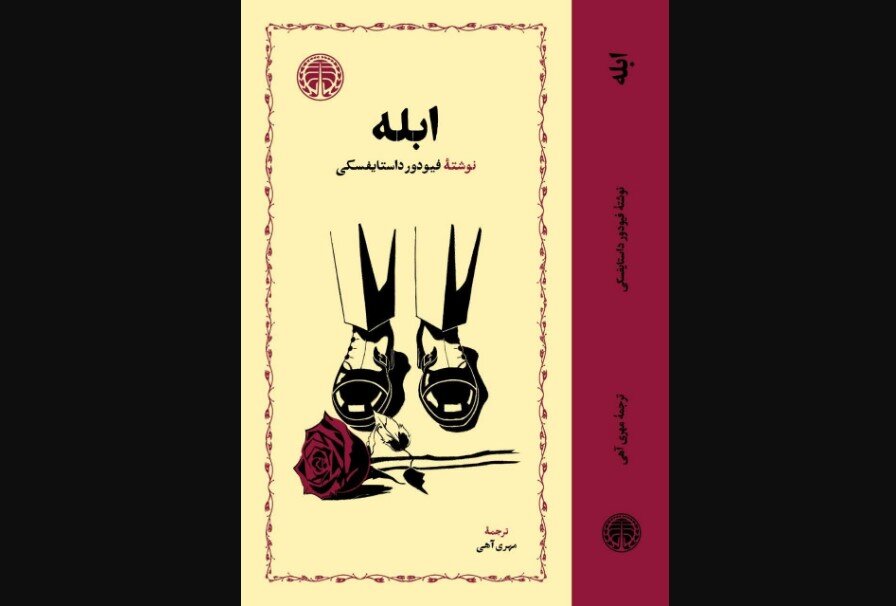
TEHRAN – The fifth edition of the Persian translation of Russian author Fyodor Dostoyevsky’s 1869 novel “The Idiot” was recently released by Tehran’s Karazmi Publishing.
Translated by Mehri Ahi, the first edition of the Persian translation was published in 2016.
The Idiot is a profound novel centered around Prince Myshkin, a young man in his mid-twenties who embodies innocence, compassion, and moral integrity. Myshkin, a descendant of Russian aristocracy, has spent the past four years in a Swiss clinic recovering from severe epilepsy. On a cold November morning, he headed to St. Petersburg, eager to reunite with his distant relatives and explore his homeland.
During his journey, Myshkin meets Parfyon Rogozin, a passionate merchant who has recently inherited a huge fortune. Rogozin is infatuated with Nastasya Filippovna, an attractive but troubled woman known for her tragic past and ruthless insight into her exploitation by her former guardian, Tootsky. Rogozin’s intense love for her contrasts sharply with Myshkin’s gentle and empathetic nature. Also present is Lebediev, a civil servant and social gossip, who becomes attached to Rogozin as soon as he realizes his identity.
Myshkin’s main purpose in St. Petersburg is to meet his relative Lizaveta Prokofievna and her daughters Aglaya, Alexandra and Adelaida. During the visit, Myshkin shows frankness and philosophical views, discussing themes such as love, death, and justice. His innocence and frankness intrigue the family, especially Aglaya, and she is attracted to him despite his teasing. Myshkin also learns about Nastassya Filippovna’s complicated relationship with the men who compete for her affections, especially Ganya, Totsky, and Rogozhin.
The story unfolds during a social gathering, including Nastasya Filippovna’s chaotic birthday party, where tensions boil over. With sincerity and kindness, Myshkin proposes marriage to Nastassya Filippovna, but in despair she accepts. Her decision, torn between Myshkin’s purity and Rogozhin’s obsessive love, sets off a series of tragic events. Nastassya Filippovna’s tragic fate culminates in Rogozhin’s obsessive murdering her in a fit of jealousy.
After her death, Myshkin’s mental state deteriorated. He descends into insanity and is eventually institutionalized. Rogozin is sentenced to Siberian labor, while the Epanchins and Aglaya face their own disillusionment. The novel explores themes such as purity and corruption, spiritual purity, and the devastating effects of moral blindness in a society caught between materialism and moral decadence.
When The Idiot was published in Russia, it received mostly negative reviews. Critics opposed Dostoevsky’s perceived conservatism and sought to undermine his political intentions. The main criticism centered on the “fanciful” nature of the characters, with critics dismissing their actions as whimsical and lacking artistic truth. Some criticized the novel as a subjective collection of absurd characters and events, while others praised Dostoevsky’s attempts to depict the good while criticizing the novel’s inconsistent depiction of its characters.
Dostoyevsky responded by calling his style “fantastic realism” and claiming that it was more truthful than traditional realism and could predict future developments. European critics also found the novel to be formless and rambling, and described it as confusing. Although modern critics acknowledge these structural flaws, they see them as inherent to Dostoevsky’s experimental approach, and Bakhtin sees the novel’s unpredictability as a reflection of Dostoevsky’s innovative, carnivalesque style.
Various filmmakers, including Kurosawa and Tarkovsky, adapted The Idiot, but Tarkovsky’s plans were thwarted by Soviet censorship. The novel has also inspired television, radio, and operatic adaptations around the world.
SAB/