
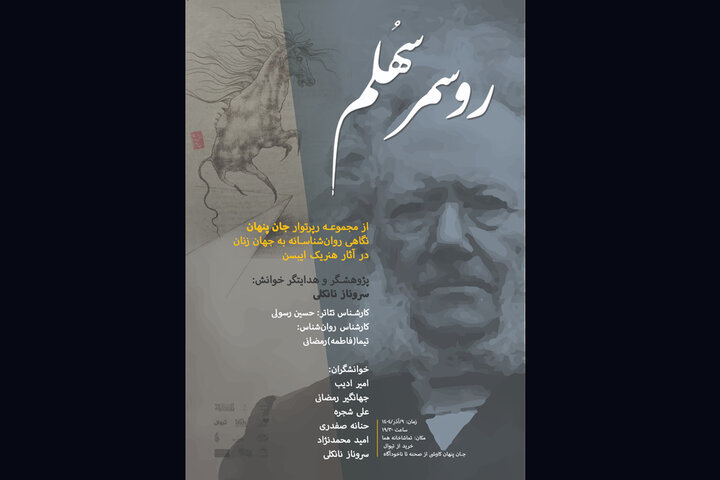
TEHRAN – Iranian director Sarvenaz Nankari staged a reading of Norwegian playwright Henrik Ibsen’s “Rosmarsholm” at Tehran’s Homa Theater Hall on Sunday.
The performance was performed by a cast consisting of Amir Adib, Jahangir Ramezani, Ali Shajareh, Hannane Safdari, and Omid Mohammadnejad.
Henrik Ibsen’s 1886 Rosmarsholm is widely known as one of his most complex and enigmatic plays. The play explores deep themes of morality, social change, and the inevitable influence of the past. Set in the midst of personal tragedy and political turmoil, “Rosmarsholm” examines the psychological turmoil of its characters as they grapple with guilt, faith, and a desire for rebirth. Often admired for its subtlety and layered symbolism, it is considered one of Ibsen’s most profound works, along with “The Wild Duck.”
The central character is Johannes Rosmel, a former clergyman and aristocrat who owns the Rosmelsholm estate. Haunted by the suicide of his wife Beata, Rosmar is torn between his aristocratic heritage and his revolutionary ideals of social reform. Rebecca West is a resilient and morally ambiguous woman who lives in Rosmarsholm and has a past involving Beata’s death. Although their relationship is close and intense, Rozmar insists that it remains purely platonic. As the play unfolds, their bond becomes a battleground of moral conflict, desire, and guilt.
The story takes place one year after Beata’s death. Rebecca, who used to be Beata’s friend, now lives in this mansion, and it has become clear that her presence will lead to tragedy. Rosmah, who is respected in the community, supports a reformist government, which puts him at odds with conservative locals. His brother-in-law, Professor Kroll, strongly opposes Rosmer’s political stance, seeing it as a betrayal of his aristocratic roots. Hostility intensifies when Kroll publishes an article criticizing Rosmell and Rebecca, fueling suspicion, guilt, and internal conflict within Rosmell.
The climax occurs when Rozmar, wracked with guilt and despair, asks Rebecca to marry him. Although she struggles with her own moral failings and admits that she has contributed to Beata’s despair, she rejects him. Her confession reveals her complicity in the tragedy and destroys their fragile trust. In despair, Rosmar asks Rebecca to prove her devotion by killing herself in a waterwheel race, like Beata. Rebecca calmly agrees and instructs the body to recover, with Rozmar joining her. The play ends with their deaths, symbolizing the destructive power of sin and the inability to reconcile with the past.
“Rosmarsholm,” named after its protagonist, reflects the Norwegian legend of Rosmar Havmand, a half-mermaid who lures women to his death, and is an allegory for the play’s themes of fatal attraction and moral ambiguity. The original title “White Horses” emphasizes the supernatural and ghostly elements that pervade the story.
Ibsen’s personal background greatly influenced this play. The themes of lost joy and social change reflect his own experiences and observations of Norwegian society.
“Rosmarsholm” is a powerful exploration of the moral dilemmas faced by people caught between tradition and reform. Its layered symbolism, ambiguous ending, and psychological depth continue to resonate with audiences and scholars alike. One of Ibsen’s most delicate and profound plays, it challenges viewers to confront their own ghosts, the weight of history, and the potential for personal and social renewal.
Henrik Ibsen (1828-1906) was a major Norwegian playwright who was largely responsible for the rise of modern realistic theater. He is often called the “father of modern drama.” Ibsen is considered Norway’s greatest writer and one of the most important playwrights of all time, and is hailed by Norwegians as a national symbol.
Although he was a pioneer of theatrical realism, he also wrote lyrical epic works. Ibsen is the world’s most frequently performed playwright after Shakespeare, and A Doll’s House became the world’s most performed play in 2006.
SAB/