
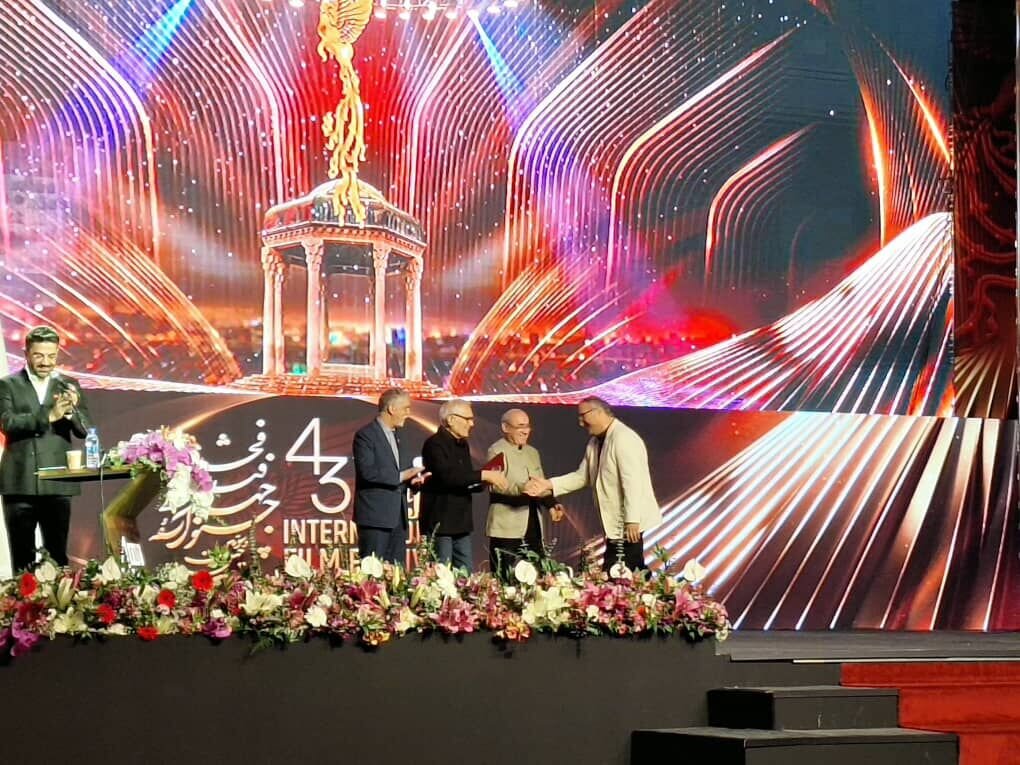
TEHRAN – The 43rd Fajr International Film Festival (FIFF) concluded on Tuesday evening with an awards ceremony held at Honar Shahr Aftab Cineplex in Shiraz, Fars province.
According to the festival’s website, the closing night brought together dignitaries including Minister of Culture and Islamic Guidance Seyed Abbas Salehi, Iranian Film Institute President Raed Farizadeh, and Fars Governor Hossein Ali Amiri, as well as filmmakers, industry experts, and members of the media.
At the closing ceremony, the Minister of Culture welcomed Aurangzeb Khan Kich, Minister of National Heritage and Culture of Pakistan, high-level film delegations from 15 countries, ambassadors to Iran, and distinguished guests from all over Iran and around the world, saying, “The Fajr International Film Festival is an opportunity to reflect on the art that has taught us to see differently over the years, the art that gives us the courage to imagine.” It gives meaning to the story. ”
Referring to current global issues, Salehi said, “Our country shares the suffering of the oppressed peoples of Palestine and Gaza, and just a few months ago we experienced difficult days of war. During the 12-day war launched by the child-killing Zionist regime, the brave sons of this land sacrificed their lives to protect Iran’s security and dignity.”
Commenting on the role of cinema in this situation, he added: “At times like this, art cannot remain silent and cinema can become the narrator of this resistance. Cinema can preserve these wounds and acts of courage so that the collective memory of Iran and the world can remain bright and enduring.”
“The Fajr International Film Festival shows how cinema can bring countries closer together and enable dialogue. The presence of filmmakers and guests from different countries shows that today’s world needs honest, humane and thoughtful stories more than ever,” he added.
“In this situation, as a member of the Government of the Islamic Republic of Iran, I must emphasize that, despite our differences, we believe that our common values should be the starting point for international cooperation and joint film production. Sharing experiences, whether in production or research and development, opens new gateways for exchanging knowledge, technology and artistic vision. Iranian cinema is ready to take a longer and more confident step on this path.”
At the ceremony, Reza Mirkarimi, acclaimed Iranian director and screenwriter and former executive director of the Fajr International Film Festival, was honored for his contribution to cinema.
This year’s festival presented awards in four categories: International Competition, Eastern Vista (Asian Films), Future Frames (First and Second Films), and Broken Olive Branch.
In the International Competition category, Hungary’s Balint Simler’s “Lessons” won the Krystal Simurgh Award for Best Film, while Japan’s Masakazu Kaneko’s “River Returns” won the Special Jury Award.
The awards for Best Director and Best Screenplay at the Kristall Simurg Awards went to Martin Pavol Repka for the Czech Republic film “March to May” and to Elena Kiseleva and Andrei Konchalovsky for the Russian film “Look at Me”.
The Crystal Simurgh Award for Best Artistic Contribution was awarded to young actor Ahmed Malek for “Fragrance of the Father,” a film directed by Mohamed Siam and co-produced by Egypt, Norway, Sweden, Saudi Arabia, Qatar, and France.
In the East Vista category, Russian director Michael Lukachevsky’s “Where the White Cranes Dance” won the Crystal Simurg Award for Best Film.
The Crystal Simurgh Award, a special jury award, went to The Settlement, directed by Mohamed Rashad from Egypt, Qatar, Germany, France and Saudi Arabia.
The Krystal Simurgh Award for Artistic Contribution went to Behnoush Sadeghi, the Iranian director of Calm Man, for his work in coordinating the interplay of the film’s creative elements, from acting to cinematography to set and costume design.
In the Belly of a Tiger, directed by Indian director Jatra Siddhartha, received a special award in this category.
In the Future Frame category, the Crystal Simurgh Award for Best Picture was jointly won by Tunisian director Mohamed Ali Nahadi’s “Round 13,” and Iranian, Australian, and Canadian director Ronak Taher’s “The Two Faces of Autumn.”
The Special Jury Prize, Crystal Simurgh, was awarded to Lalith Rathnayake from Sri Lanka for “Riverstone”.
In the “Broken Olive Branch” category, the jury awarded the Crystal Simurgh Award for Best Picture to Sherian Davis’ “All That’s Left of You,” a co-production between Germany, Cyprus, Palestine, Jordan, Greece, Qatar, and Saudi Arabia.
The Special Jury Prize went to Rashid Masharawi’s From Ground Zero, a co-production between Occupied Palestine, France, Qatar, United Arab Emirates, Switzerland and Denmark, for its powerful and convincing portrayal of the reality and suffering endured over the past two years as seen through the lens of 22 artists from Gaza.
“Valley of Exile” by Canadian-Lebanese Anna Farr received a special award in this section for its remarkable visionary style.
Photo: Reza Mirkarimi (right), a prominent Iranian film director and former executive director of the Fajr International Film Festival, was honored for his contribution to cinema at the closing ceremony of the 43rd International Film Festival in Shiraz on December 2, 2025.
SS/