
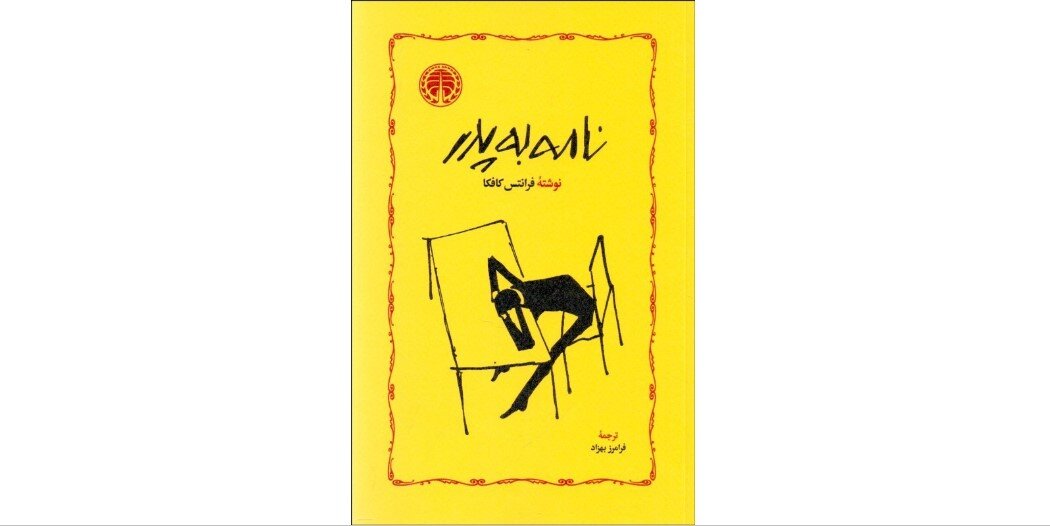
TEHRAN – A Persian translation of Czech writer Franz Kafka’s book “Letters to My Father” was recently published by Tehran’s Karazmi Publishing.
Faramarz Behzad is the translator of this book, first published in 1919.
Franz Kafka wrote a scathing and confrontational letter to his father Hermann, which has since become known as the “Letter to My Father” (German: “Brief an den Vater”). This seminal work provides deep insight into the complex and often turbulent relationship between two men.
As documented by Kafka’s biographer Max Broad, this letter was given to Kafka’s mother with instructions to deliver it to his father. However, this mission was never completed, and the original manuscript, consisting of 45 typewritten pages with extensive handwritten corrections, remained unpublished.
The letter was first translated into English by Ernst Kaiser and Eisne Wilkins and published by Schocken Books in 1954 as part of the collection Dearest Father: Stories and Other Writings. A bilingual edition was published in 1966. A new translation by Hannah and Richard Sievers has recently been published, offering readers a fresh and nuanced understanding of this vital work.
Franz Kafka (1883 –1924) was a famous Czech-born writer who wrote in German. Kafka was born into a middle-class Jewish family in Prague, then part of the Austro-Hungarian Empire, and is considered a major figure in 20th century literature.
His works combine realism and fantasy, often depicting lonely protagonists confronting bizarre, surreal situations and oppressive bureaucracies. The term “Kafkaesque” is commonly used to describe such disorienting and oppressive scenarios.
His most famous works include the novella “The Metamorphosis” (1915) and the novels “The Trial” (1924) and “The Castle” (1926). Kafka’s influence spans many fields, influencing artists, philosophers, filmmakers, and cultural theorists.
Despite his literary success, Kafka trained as a lawyer and took a job in law and insurance, but internal conflicts arose given his true passion for writing.
Only a few works were published during his lifetime, including “Contemplations” (1912) and “The Country Doctor” (1919). He maintained a strained relationship with his father, writing to him numerous times.
Kafka died of tuberculosis at the age of 40, but at the time he was little known. In addition to his novels and stories, he is also famous for his aphorisms and fables, which often combine dark themes with moments of humor, and his writings are sometimes considered prophetic of future totalitarian regimes.
SAB/