
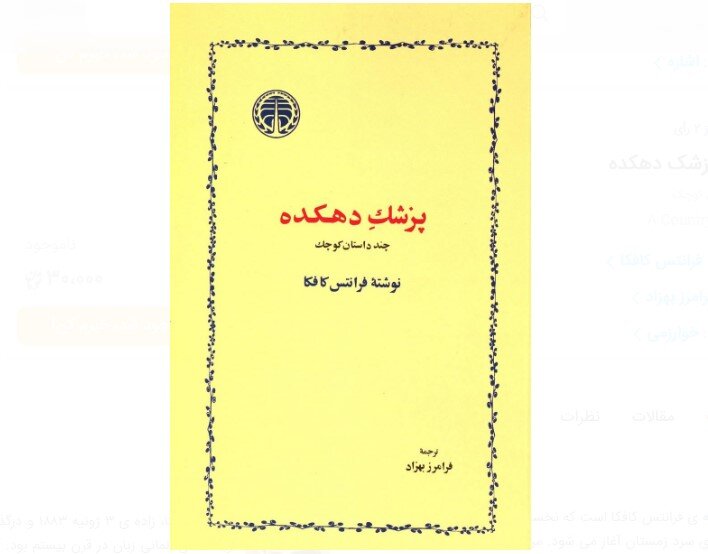
TEHRAN – The fifth edition of the Persian translation of Czech author Franz Kafka’s 1919 short story collection “The Country Doctor” has recently been released by Tehran’s Karazmi Publishing.
The first edition of the Persian translation, translated by Faramarz Behzad, was published in 1978.
“The Country Doctor” was originally published as a collection of short stories with the same title. The story revolves around the ill-fated visit of a rural doctor who visits a sick patient on a frigid winter night. As the Doctor navigates treacherous terrain, he encounters a series of absurd and surreal events that ultimately lead to his downfall.
The plot of the story follows a country doctor’s ill-fated attempts to contact a young boy in a remote village ten miles away who is in need of treatment. The Doctor’s journey is marked by a series of strange events.
The Doctor becomes entangled in an increasingly surreal web of predicaments as he faces various obstacles, including treacherous roads, bad weather, and mysterious strangers. The story builds toward a sense of inevitability as the Doctor’s fate becomes increasingly determined. Through this story, Kafka explores themes of isolation, alienation, and the absurdity of human existence, all characteristics of his unique literary style. The Country Doctor remains one of Kafka’s most enigmatic and thought-provoking works, continuing to captivate readers with its haunting and disturbing depiction of the human condition.
Franz Kafka (1883 –1924) was a famous Czech-born writer who wrote in German. Kafka was born into a middle-class Jewish family in Prague, then part of the Austro-Hungarian Empire, and is considered a major figure in 20th century literature.
His works combine realism and fantasy, often depicting lonely protagonists confronting bizarre, surreal situations and oppressive bureaucracies. The term “Kafkaesque” is commonly used to describe such disorienting and oppressive scenarios.
His most famous works include the novella “The Metamorphosis” (1915) and the novels “The Trial” (1924) and “The Castle” (1926). Kafka’s influence spans many fields, influencing artists, philosophers, filmmakers, and cultural theorists.
Despite his literary success, Kafka trained as a lawyer and took a job in law and insurance, but internal conflicts arose given his true passion for writing.
Only a few works were published during his lifetime, including “Contemplations” (1912) and “The Country Doctor” (1919). He maintained a strained relationship with his father, writing to him numerous times.
Kafka died of tuberculosis at the age of 40, but at the time he was little known. In addition to his novels and stories, he is also famous for his aphorisms and fables, which often combine dark themes with moments of humor, and his writings are sometimes considered prophetic of future totalitarian regimes.
SAB/