
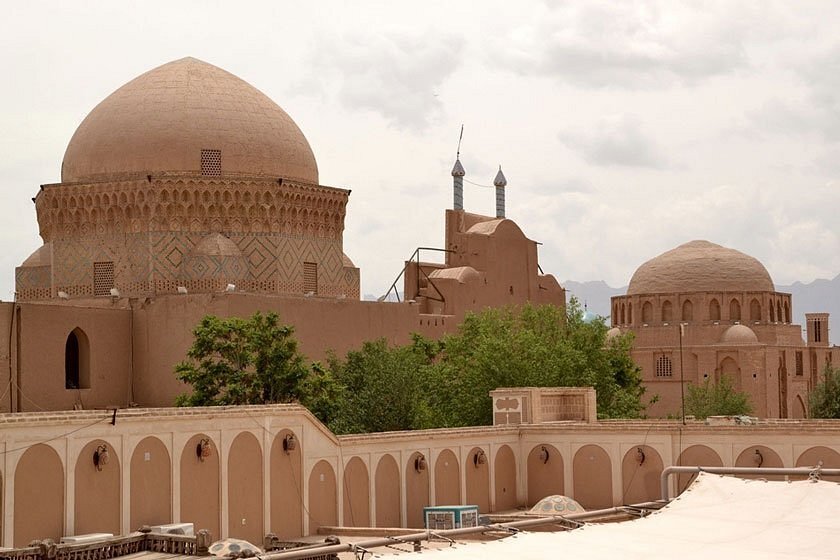
TEHRAN – This enigmatic monument, locally known as Zendan-e-Eskander (Alexander’s Prison) and more formally as Ziaiya School, stands among the most interesting historical sights of Yazd, a UNESCO World Heritage Site oasis city famous for its earthen architecture and deep cultural continuity.
Located in the historic Fahdan district, this maze of adobe alleys and wind-roofed houses represents a fascinating blend of history, architecture and legend.
Despite its evocative name, Alexander Prison was not a prison in the traditional sense. According to historical evidence, the complex was built in 631 AD (13th century AD) and completed in 705 under the patronage of Zia al-Din Hossein, father of the renowned historian Sharaf al-Din Ali Yazdi. Originally built as a seminary, the school reflects the educational and spiritual life of medieval Iran during the Ilkhanid (Mongol) era.
Architecturally, the monument is a masterpiece of Azerbaijani style, characterized by restrained decoration and structural innovation. Built almost entirely of sun-dried adobe bricks, the complex has shown remarkable durability in Yazd’s harsh desert climate. At its heart stands an impressive dome, approximately 18 meters high, built using sophisticated double-shell technology.
The transition from a square base to a circular dome is achieved by the innovative features of Persian architecture. Traces of delicate plasterwork, once decorated with gold and azure pigments, still testify to the building’s former splendor.
The layout is centered around a spacious courtyard surrounded on three sides by arcades (riwak), rooms, and iwans. The western iwan is particularly notable, featuring a finely decorated mihrab. Beneath the courtyard is an underground space, accessed through a well-like shaft, which adds to many of the mysteries of the site. This deep pit is often described as a dungeon and has been the center of an enduring legend linking this place to Alexander the Great.
According to local legend, Alexander ordered the construction of a prison here when he conquered Persia in the 4th century BC. Some stories claim that dissidents were imprisoned in the cellars, while others suggest that the name appeared later, inspired by poetic references such as Hafez, who used the term “Alexander’s prison” figuratively in his poems. Historians largely dismiss these claims as myths, but legends continue to enrich the cultural aura of the place.
Today, the monument partly functions as a small museum, displaying ancient tombstones, inscriptions, and archaeological finds from the area. Careful restoration work using traditional materials such as adobe bricks has preserved its authenticity. The site was officially inscribed on Iran’s National Heritage List in 1968, highlighting its historical importance.
Alexander Prison is ideally located for visitors exploring Yazd’s historic center. Nearby attractions include Tombs of the Twelve Imams, Lari House, and Jamek Mosque in Yazd. All of these contribute to the city’s rich architectural tapestry.
For travelers, a visit to Zendaan-e-Eskander offers not just a glimpse into the past, but an immersive encounter with the layered stories of Iranian history, where architecture, legends and cultural memory converge in one of the country’s most atmospheric environments.
A destination not to be missed
In July 2017, the historical center of the provincial capital, Yazd, was declared a UNESCO World Heritage Site. Yazd is consistently mentioned by almost all visitors as a fun place to stay or a ‘must-see’ destination. The city is filled with adobe houses with innovative badghirs (wind catchers), atmospheric alleys, and many Islamic and Iranian monuments that form an eye-catching cityscape.
Cultural heritage experts believe that Yazd is a living proof of the wise use of the desert’s limited resources for survival. Water is transported into the city by the qanat system. Each district of the city is built on a qanat and has a community center. Additionally, the use of earth in buildings includes walls and roofs through the construction of vaults and domes. The house is built with an underground courtyard, which feeds the underground area. Wind shelters, courtyards and thick earthen walls create a comfortable microclimate.
Yazd’s historic center is packed with adobe houses, bazaars, public baths, reservoirs, mosques, synagogues, Zoroastrian temples, and centuries-old gardens. From a divine perspective, the city is home to three religions that coexist peacefully: Islam, Judaism, and Zoroastrianism.
Yazd is home to many qanats that have provided water for agriculture and settlements for thousands of years. The human-carved underground qanat system relies on snow-fed streams flowing at the foothills of the surrounding mountains. The earliest water supply to Yazd is estimated to date back to the Sasanian period (224-651 AD). However, many other reservoirs have been continuously repaired and used over time, and most of the remaining Abu Anbar (traditional adobe reservoirs) can be traced back to the late Safavid and Qajar eras.
morning