
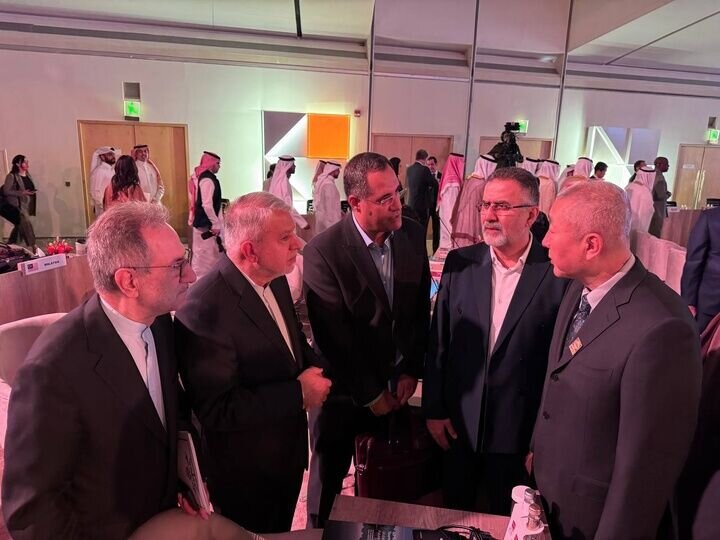
TEHRAN — Minister of Cultural Heritage, Tourism and Handicrafts Seyed Reza Salehi Amiri met with Chinese Minister of Culture and Tourism Sun Yeri and Iraqi Minister of Culture, Tourism and Antiquities Ahmed Fakaq al-Badrani during the 26th United Nations Tourism Assembly, which officially opened in Riyadh, Saudi Arabia on Sunday.
According to IRNA, Foreign Minister Salehi Amiri underlined the beginning of a new phase of tourism cooperation between Iran and China, stressing that developing cultural exchanges and attracting a share of China’s vast tourism market are among the main priorities of Iran’s tourism policy.
During the meeting, both sides emphasized strengthening economic ties between Tehran and Beijing, as well as promoting tourism and cultural ties. The two countries agreed on a joint plan to increase the volume of mutual tourists and exploit the immense potential of China’s tourism market.
Salehi-Amiri referred to China’s privileged position in the global tourism sector, noting that China sends more than 160 million tourists abroad annually and plans to increase this number to 200 million. “If Iran can attract even 1 percent of this capacity, more than 2 million Chinese tourists could visit Iran annually. This is a strategic number that could revolutionize the country’s tourism industry,” he said.
Salehi Amiri stressed the need for tourism exchanges, cooperation in organizing cultural and exhibition events, and increased communication between tourism experts from both countries.
He noted China’s positive attitude towards Iran and said there were no issues between the two countries. He further stated that “the peoples of Iran and China have a constructive view of each other, and this foundation of mutual trust will pave the way for sustainable cultural and tourism cooperation.”
“We consider China a strategic partner in the global tourism industry, and believe that cooperation between the two countries will be a successful model for Asian cooperation in the tourism field,” he said.
During the meeting, China’s Culture and Tourism Minister expressed gratitude for Iran’s support in Saturday’s vote at the World Tourism Forum, which helped China secure a seat. He stressed the importance of maintaining friendly and strategic relations between Tehran and China.
“I believe that expanding cultural and tourism cooperation can strengthen the relationship between our two countries and strengthen economic exchanges,” Sun Yeri said.
At the end of the talks, the two ministers agreed on a series of joint measures, including designing tourism exchange programs between Iran and China, participating in each other’s cultural and exhibition events, leveraging China’s tourism market to promote Iran’s attractiveness, and expanding technical and economic cooperation in the tourism field.
Continuing efforts to strengthen cultural diplomacy between Iran and Iraq, the two countries’ tourism ministers also met to discuss expanding tourism cooperation and strengthening pilgrimage infrastructure. The two sides agreed on a joint plan to increase people-to-people exchanges, promote mutual travel, and establish a specialized committee to develop pilgrimage and tourism.
In a meeting with Iraq’s Minister of Culture, Tourism and Cultural Heritage, Salehi-Amiri mentioned the unique significance of the Arbaeen ritual, which marks the end of the 40-day mourning period after the martyrdom of Imam Hussein (AS) and his companions at the Battle of Karbala in 680 AD.
He said the Arbaeen ritual is the world’s largest religious and spiritual gathering and deserves to be included in UNESCO’s list as an element of the intangible cultural heritage of humanity. “This ceremony is a symbol of love, faith and unity between the people of Islamic countries, especially Iran and Iraq,” he added.
Thanking the Iraqi people for their hospitality during Arba’een, Foreign Minister Salehi-Amiri said that the Iraqi people’s generous treatment of Iranian pilgrims is an expression of the heartfelt ties between the two countries, which should be institutionalized through sustainable cultural and tourism cooperation.
Foreign Minister Salehi Amiri said Iraq is one of Iran’s most important tourism partners. “Last year, more than 3.5 million Iranian pilgrims visited Iraq (not including those attending Arbaeen) and about the same number of Iraqi pilgrims visited Iran. Our goal is to increase this number to 5 million reciprocal tourists next year,” he said.
He emphasized that achieving this goal requires creating incentives and improving transport and accommodation facilities. “The governments of Iran and Iraq, together with industry associations and tourism activists, can reduce travel costs and increase people-to-people exchanges by designing support packages,” he added.
He also mentioned the need for mixed tourism development between the two countries. “In addition to holy sites, Iraqi pilgrims visit Iran’s natural and cultural attractions. We also hope that Iranian pilgrims benefit from Iraq’s historical, cultural and natural attractions, and that the concepts of pilgrimage, tourism and health tourism are institutionalized in both countries,” he said.
Foreign Minister Salehi Amiri welcomed the establishment of a joint technical committee on tourism between Iran and Iraq to address obstacles, noting that such a committee could help remove travel barriers, develop infrastructure and strengthen cooperation in managing pilgrimage tourism.
Iraq’s Minister of Culture, Tourism and Cultural Heritage welcomed Salehi Amiri’s proposal, saying, “The State of Iraq welcomes the expansion of cultural and tourism cooperation with the Islamic Republic of Iran. Arbaeen is a common heritage and a source of pride for both countries, and we are ready to work with Iran towards its global registration.”
He further emphasized the importance of increasing people-to-people exchanges, adding: “The creation of reciprocal facilities for pilgrims, accelerating transport services and improving accommodation infrastructure are among our priorities. Both Iran and Iraq share historical ties, which must be strengthened through sustainable cultural cooperation.”
At the end of the meeting, the two ministers highlighted a series of joint actions, including promoting the global inscription of the Arbaeen Husayni ritual on UNESCO’s list of intangible cultural heritage, increasing mutual tourism between Iran and Iraq to 5 million visitors per year, establishing a joint technical tourism committee to remove obstacles, and developing a “pilgrimage and tourist tourism” model between the two countries.
Foreign Minister Salehi Amiri said these agreements are an important step towards strengthening cultural and people-to-people diplomacy between Iran and Iraq, stating that “Iran and Iraq are partners and allies in their cultural, religious and spiritual heritage.”
KD