
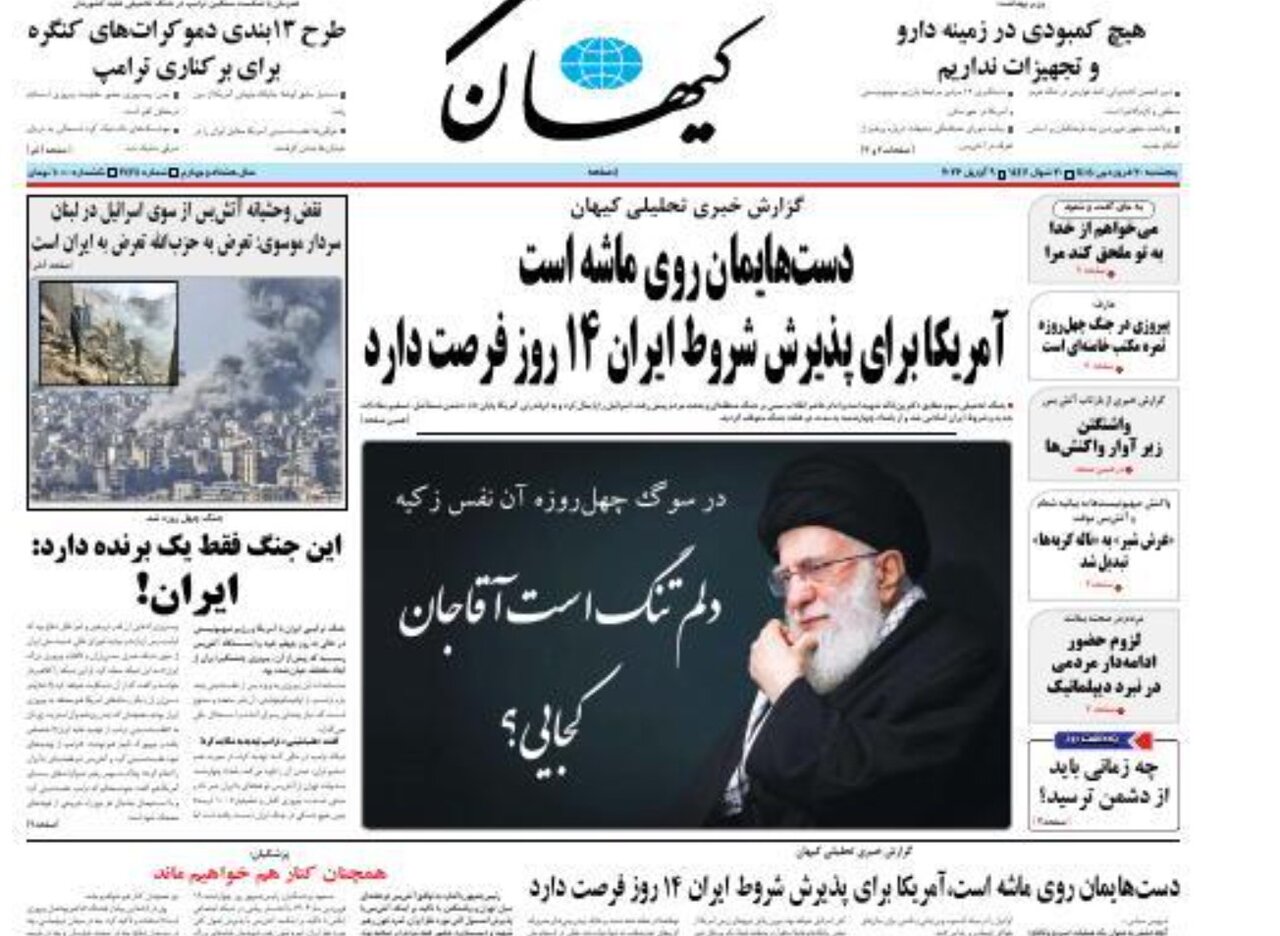
In his article, Kayhan referred to Iran’s power and readiness to defeat American hegemony. “What the enemy had planned as a swift and decisive operation turned into a ‘disgraceful and historic defeat,'” the paper wrote. The Islamic Republic of Iran is the world’s superpower, and its hand is on the trigger.
The third imposed war evolved accordingly, trampling on Israel and ending America’s superpower status. The desperate enemy surrendered to the new formula and conditions laid down by the Islamic Republic of Iran, and the war was suspended for two weeks. These victories were the result of the bond between “the wise leadership of the revolution, the steadfastness of the military, and the intelligent presence of the people.”
Etemad: Iran-led temporary ceasefire
In an interview with university professor Hossein Rabiei, Etemad explored the ceasefire and negotiations between Iran and the United States. If the conditions specified by Iran, the same 10-point package, become the basis for action and are accepted by the United States, there is hope that this ceasefire will turn into a lasting peace. During the negotiation process, it is necessary to observe the extent to which both sides consider and intend to respect the red lines they have set and the limits they have set for engagement. We hope that the United States will be able to accept Iran’s terms. The terms Iran is offering, if accepted by the United States and the international community, could lead to the peace we have in mind.
Iran: Diplomatic struggles parallel to war
War will never end. It simply moves from one format to another. Therefore, the ceasefire and suspension of military operations in the Ramadan War do not mean the end of fighting. Rather, they mark the end of the war and the beginning of a new type and stage of diplomatic warfare in another field: that of negotiation and bargaining. The main goal of this new phase is to turn ceasefires into lasting peace and turn temporary, short-term gains into permanent, long-term assets. With the establishment of a two-week temporary ceasefire, Iran has entered an arena and battlefield more complex, uncertain, and filled with ambiguity and mistrust than the military stage. By developing, pursuing, and implementing a layered and multidimensional military defense strategy, Iran imposed its will on its enemies and forced them to retreat. The prerequisites for “armed diplomacy” are discursive unity, integrated governance, unified command, single structure and centralized decision-making, national spirit and unity, and coordination and synergy between the battlefield and diplomacy.
Hamshahari: Either a deal accepted by Iran and the resistance, or a return for the US and Israel under fire
In his analysis of the negotiations in the midst of the war, Prime Minister Hamshahari wrote: Iran has so far indicated that it will continue to abide by its agreements and obligations, as it has always done, but it is closely monitoring all possible scenarios for the future and will act depending on the timing and atmosphere of the relationship. One possible scenario for the United States is to disrupt the negotiation process, prevent Iran from reaching an agreement that secures the rights of the resistance, and keep Israel on the battlefield with Iran and Lebanon. The United States cannot in any way escape the consequences of terminating the cease-fire agreement, which does not result in an outcome acceptable to Iran and the resistance. Therefore, if the temporary ceasefire were to end due to violations by the other side or failure to reach an agreement acceptable to Iran and the Resistance in time, as we think is reasonable, then American interests throughout the region would be rekindled, just as they were before the fires stopped.
Armand-Emroos: A ceasefire to continue to consolidate gains
Armaan Emrouz assesses the current situation in his analysis and writes: From a strategic point of view, the difference between this situation and previous ceasefires is that this time the cessation of hostilities was accepted in circumstances where the balance had shifted in Iran’s favor. In other words, this ceasefire is not pursued from a position of weakness, but rather as a continuation of efforts to consolidate gains and turn them into political gains. Observers believe that what occurred during this period was not simply limited military conflict, but rather a combination of power on the ground, political management, and social cohesion. According to social issues analyst Mohammad Ghazwini, the new situation has created an opportunity to strengthen avenues of constructive engagement that leverages international capabilities and pursue national interests within a stable framework. In his view, a combination of domestic strength and active diplomacy can enhance a country’s standing in the regional and global equation.