
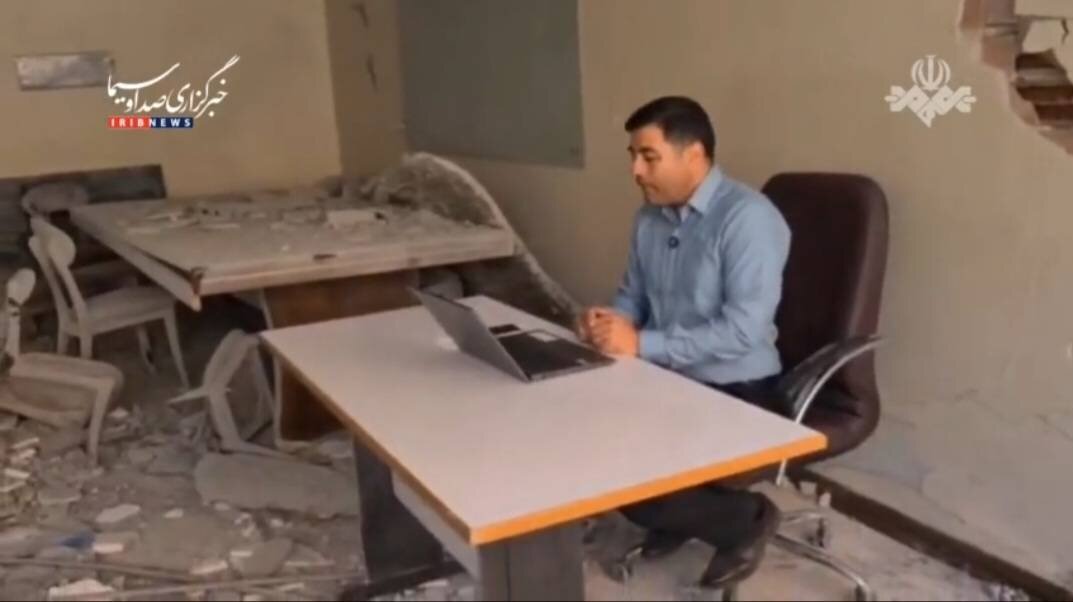
TEHRAN – Just one day after the United States and Israel bombed Tehran’s Sharif University of Technology on Monday, Alireza Zaray, a teacher in the mathematics department, decided to continue teaching online from his office, which was reduced to rubble.
Debris was scattered on the floor. The potted plants were covered in dust. Jagged cracks ran up the wall, exposing the bricks beneath.
The scene was witnessed by reporters a day after U.S. and Israeli airstrikes hit the university, one of Iran’s leading scientific institutions, severely damaging an IT center building and a gas substation near a nearby mosque, Xinhua News Agency said.
Parts of the campus were reduced to rubble. Scattered rubble, twisted rebar and exposed building skeletons made the scene look more like a battlefield than a university.
But even amidst its ruins, this place remains an undeniably academic place. Textbooks and documents are scattered among the broken equipment. Above all, the voices of teachers who continue to teach with a resolute attitude resonate.
Mr. Zarei is one of those professors. On Tuesday, he began teaching graduate students who attended classes online, as the current situation precludes in-person classes.
Mr. Zarei began the class by praying for the glory, honor and dignity of Iran, and for the health of the students.
“On Sunday, I wanted to teach the next class in the classroom on Tuesday. Back then, it didn’t seem possible. Now, I am proud to hold the class at the Information Technology Center, the center of research and education at Sharif University of Technology.”
The professor emphasized that the enemy did not just destroy buildings, but targeted the (country’s ancient) civilization, a measure that only a Stone Age mind that calls itself human without humanity could take.
“We believe in God. We believe we will win,” Zarei stressed.
For University President Massoud Tajrishi, every corner of campus was once a familiar place. But even he had to stop from time to time to see what had once stood there as he showed reporters the aftermath of the bombing.
“I ask you all, and I hope that you will not see this destruction as a decline or weakening, but rather as an expression of ‘enemies’ hostility’ towards Iran’s scientific and technological progress,” Tajirisi told reporters.
“We at the University are moving hand in hand towards this great victory,” he added. “We will build this country again.”
Sharif University of Technology is not the first educational institution to be attacked in the recent US-Israeli attacks.
On April 7, Iran’s ambassador to the United Nations accused the United States and Israel of deliberately targeting Iranian universities and scientific institutions in an “unprecedented act of barbarity,” calling the attacks a war crime that no amount of threats or military pressure can quell.
Ambassador Amir Saeed Irabani detailed a coordinated campaign of state terrorism in a series of letters to the U.S. Secretary General and Security Council this week.
He cited the early-morning airstrike on April 6 that caused extensive damage to Tehran’s Sharif University of Technology, which includes the faculties of civil engineering, electrical engineering, and research institutes for nanotechnology and environmental research. The attack follows a similar attack on Shahid Beheshti University on April 3, which damaged the university’s Laser and Plasma Laboratory.
“The deliberate targeting of scientific institutions and universities is a clear violation of international humanitarian law and amounts to a war crime,” Iravani wrote.
Iranian government spokesperson Fatemeh Mohajerani, speaking at a press conference at Shahid Beheshti University, echoed the defiant attitude.
“The enemy cannot extinguish the light of Iranian science,” he said, adding that the latest attacks aim to undermine the achievements of the 47-year revolution and sever the ties between Iran and the motherland.
“These miscalculations are wrong. Iran is the common denominator for all Iranians. Those who own a homeland will support it, and Iranians living abroad will never give in.”
On Saturday, Science, Research and Technology Minister Hossein Simai Salaf said more than 30 Iranian universities have come under direct attack from the United States and Israel since the start of the war in late February.
Simai Saraf said attacks on Iranian infrastructure were “crimes against humanity”, adding that five university professors and more than 60 students were killed in the attack.
“The main reason why the enemy targeted this sensitive infrastructure is because we did not want access to this technology,” he said, adding that many Iranians abroad have contacted the university and offered to help with recovery funds.
To foreign attacks, Iranian scholars will respond in their own way in the field of science and knowledge, just as other scholars respond “in the streets” and “on the battlefield,” Tajirisi said.