
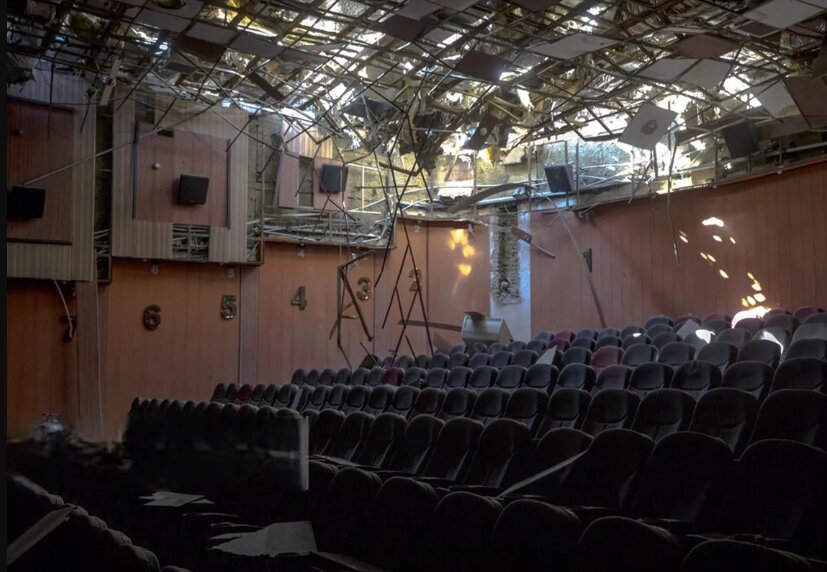
TEHRAN – Tehran’s Shokoufeh Cinema was severely damaged in recent US and Israeli attacks, and the relevant authorities are expected to assist in the reconstruction process, the cinema’s manager Ali Saltipi said.
The Shokoufe Cinema, located on Shohada Square, is one of the oldest cinemas in the capital. ISNA reports that in the early 1960s, the movie theater was one of the largest in the country, with 1,100 seats spread over 2,000 square meters.
In 2009, the cinema was acquired by Filmiran Company, run by Ali Sartipi. After renovation and the addition of three screening halls, it has reopened as one of the most equipped cinemas in southeast Tehran.
“When we bought the cinema, we took into consideration its location and space, which holds so many memories for people, and worked hard to turn it into one of the best cinemas in the region. Fortunately, over the years it has become the highest-grossing cinema in the region,” he added.
However, the Shokoufe Cinema suffered damage on the morning of March 2nd, the third day of the US-Israeli war against Iran, and was forced to close. There is currently no news regarding reopening or activities.
Mr Sartipi said cinemas had been attacked twice during the recent war. Traces of debris can be seen throughout the complex. The main hall, which can accommodate approximately 550 people, as well as the projection room, second-floor management office, screen, audio equipment, engine room, restrooms, and part of the second hall were severely damaged.
“The reconstruction will probably take about eight months. The original estimate at this time is more than 20 billion tomans (approximately $130,000). We hope that the Ministry of Culture and Islamic Guidance, the Municipality of Tehran, and all concerned and interested parties will work together to allow this complex to return to showing films.”
The United States and Israel attacked Iran on February 28, martyring more than 3,000 people, including Islamic revolutionary leader Ayatollah Khamenei, several officials, and military commanders, and numerous civilians, including women and children, over a 40-day period.
In addition to some military targets, the United States and Israel launched coordinated attacks on civilian infrastructure in several cities, including homes, hospitals, refineries, power plants, schools, universities, arts and cultural spaces, bookstores, museums, and ancient sites, causing total or partial damage and injuring innocent people.
The attack prompted a swift response from the Islamic Revolutionary Guards Corps (IRGC), which gradually escalated missile and drone launches targeting Israel and several US military bases in the region.
Iran, the United States, and Israel agreed to a two-week ceasefire on April 8, during which they plan to negotiate an end to the war.
SS/