
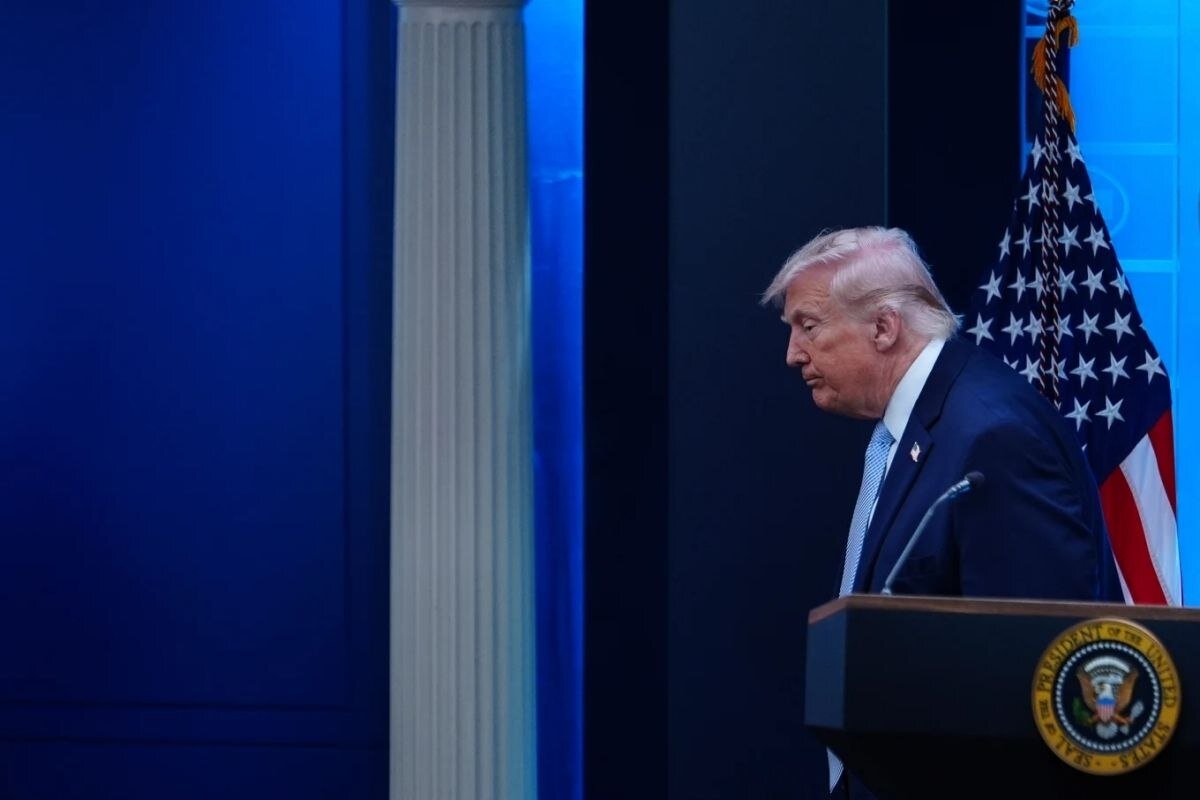
TEHRAN — The two-week conditional ceasefire between Iran and the United States announced on April 8 marks one of the most notable reversals in recent geopolitical history.
Just hours after US President Donald Trump issued a final, belligerent ultimatum to “destroy” the foundations of Iranian civilization, he announced a two-week conditional ceasefire, surprising some parts of the world.
This abrupt about-face, brokered by Pakistan and built almost entirely on the Iranian government’s own 10-point framework, has been characterized by many observers around the world as a historic capitulation.
While global markets panicked and oil prices fell below $100, the analysis was far more sobering for the West.
This was a defining TACO moment, with Trump always chickening out and the threat of maximalist annihilation collapsing into a desperate search for an exit ramp.
“Biggest loss since Vietnam”
The sense of frustration is palpable in the halls of Congress and among the foreign policy establishment.
This was supposed to be the “final reckoning” for the Islamic Republic. Rather, it became a master class in American excess.
Robert A. Pape, a prominent voice on strategic airpower, didn’t mince words, calling the result “a major strategic defeat for the United States, its greatest loss since Vietnam.”
The consensus of the adults present was that by accepting the deal based on Iran’s terms, the US government had effectively elevated Iran to the status of the world’s fourth pole.
The domestic backlash from across the aisle highlights the depth of the humiliation.
Sen. Chris Murphy accused the administration of delivering a “history-altering victory to Iran” and questioned how an operation that began with threats of total destruction ended with the United States begging to reopen the Strait of Hormuz.
Even former Trump supporters like former Rep. Marjorie Taylor Greene, Joe Kent, Alex Jones, and commentator Tucker Carlson have accepted the truth.
Former Congressman Adam Kinzinger called it “the greatest humiliation in American history,” and Ben Rhodes described the entire incident as “an absolute shame.”
On social media, the acronym “TACO” trended globally as user X pointed out that President Trump’s “art of bargaining” had turned into “art of surrender.”
Veteran negotiator Aaron David Miller said with weary resignation. “Iran won another round.”
“Donald, you came out looking like a duck.”
If the mood in Washington is bleak, the mood in Tel Aviv is bordering on apocalyptic.
It feels like Israel’s security establishment has been abandoned and left to pick up the pieces of the “security principles” that have been exposed as empty.
Prime Minister Benjamin Netanyahu’s desperate attempts to pass off the ceasefire as a victory by removing Lebanon and launching brutal attacks on civilians despite the ceasefire were quickly seen through by his rivals.
Opposition leader Yair Lapid gave a scathing autopsy, saying: “There has never been a political disaster like this in our country’s history. Netanyahu has failed both politically and strategically and has failed to achieve any of his goals.”
Knesset National Security Committee Chairman Zvika Vogel mocked President Trump’s sudden soft-pedaling and delivered a scathing rebuke: “Donald, you came out looking like a duck!”
This sentiment reflects widespread recognition within Israel. In other words, Israel cannot fight Iran without full U.S. involvement, which the U.S. government is no longer willing or able to provide.
Former intelligence officials like Danny Citrinowicz observe that the 10 points secured by Iran are more than just concessions. They are the blueprint for a new regional architecture, of which Tehran is the main architect.
Global relief and subtle rebuke
World leaders welcomed the détente but said it was a necessary step back from U.S. brinkmanship.
French President Emmanuel Macron called this “a very good thing.” German Chancellor Friedrich Merz and EU officials Ursula von der Leyen and Kaya Karas spoke of “much-needed de-escalation” and “a step back from the brink.”
British Prime Minister Keir Starmer called it a “moment of relief,” while Spanish Prime Minister Pedro Sánchez squarely criticized the Trump campaign.
Some Arab states in the Persian Gulf expressed cautious expectations for a “comprehensive and durable solution.”
China emphasized its diplomatic role, and Russia’s Dmitry Medvedev declared that America’s “one-sided, aggressive and unprovoked attacks” had resulted in a “catastrophic defeat.”
Pakistan’s mediation of Beijing’s involvement itself highlighted the changing order. Non-Western actors are now mediating things that the US government could not direct.
sovereign toll plaza
Iran’s defense strategy has successfully exposed the global economy as the ultimate victim of Western aggression, and has made the world aware of US belligerence as the main threat to international stability.
Iran’s control of the Strait of Hormuz has made the Carter Doctrine obsolete. This doctrine, built on threats of military intervention and unilateral invasion to protect Washington’s energy interests, no longer carries weight in the region.
During the 40-day invasion by the United States and Israel, oil prices soared above $120 a barrel, threatening to bankrupt the very voters President Trump needs for political survival.
Iran’s Mosaic defense is a decentralized and resilient military structure that has absorbed the impact of thousands of attacks while maintaining the ability to counterattack at will.
This resilience has forced the United States to recognize that while there is no upper limit to maximum pressure, there is no lower limit to Iran’s maximum resistance.
Now that the Islamabad negotiations have begun, it is the United States that is negotiating from an exhausted position.
Analysts now refer to the Strait of Hormuz as Iran’s sovereign tollgate, a reality that is accelerating the global de-dollarization movement and shattering the myth of Western energy security. There is no turning back now.
Aggression stagnation
Despite the victory, the Iranian people and their leaders have no illusions that the war is not over.
This two-week hiatus may only be a temporary lull in the invasion, not a permanent peace.
The deep state in Washington and the wounded psychotic bloodthirsty hawks in Tel Aviv are already looking for ways to sabotage the ceasefire.
Washington’s chief negotiator, Vice President J.D. Vance, has already called the cease-fire “fragile,” and as Israel continues its barbaric attacks in Lebanon, flare-ups are everywhere.
But the damage to Western egos, both morally and civilized, is permanent.
The world has seen sovereign and resilient nations rise up in dignity against campaigns of genocide that bring about the death of civilizations.