
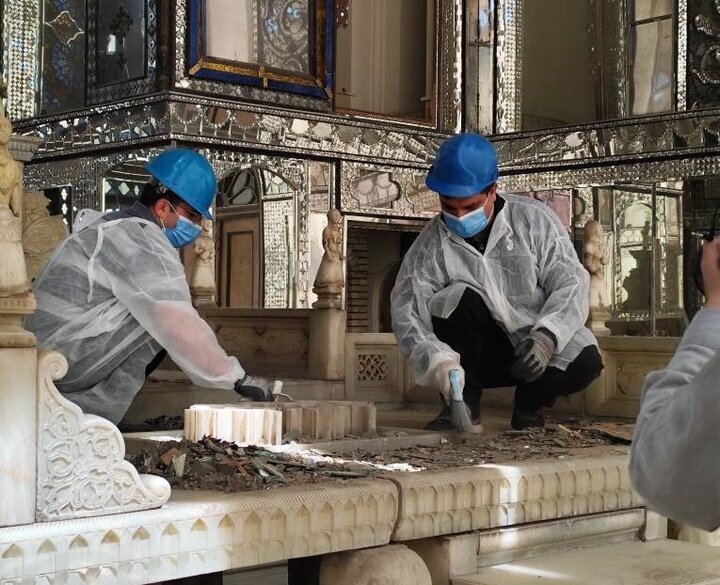
TEHRAN – Cultural heritage restorers have completed emergency preservation and documentation work on part of the Takht-e-Marmar (Marble Throne), once the royal portico of Golestan Palace, after it was damaged by shockwaves from recent air strikes, officials announced.
The damage followed an explosion near Tehran’s Arg Square on March 1 during a US-Israeli offensive that affected parts of the UNESCO World Heritage complex, one of Iran’s most important historical sites.
ISNA reported that on Wednesday, Golestan Palace World Heritage Complex Director Afarin Emami said that experts had completed the “emergency protection and documentation” of decorative elements scattered from the iwan (portico) of Takte Marmar.
“Following the damage caused by the blast and the resulting vibrations, a team of experts carried out specialized rescue and documentation operations of fragmented architectural and decorative components,” Emami added.
She said this impact influenced delicate features such as mirror work, wooden frames, intricate latticework, parquet and traditional sash windows, which were hallmarks of Qajar-era craftsmanship.
Despite ongoing hostilities at the time, restoration experts and museum staff remained on site to secure and catalog the damaged elements, she added.
The portico of Takht-e-Marmar was built in the early 19th century under Father Ali Shah Qajar and is one of the palace’s most iconic spaces. It is characterized by elaborate decoration that combines painting, calligraphy, stucco, carving, enamel, mirror mosaic, and tile work.
In its center stands the marble throne itself. It is made up of 65 pieces of yellow marble from Yazd with intricate carvings and an original design by court artist Mirza Baba Naqqash Bashi. The structure was supervised by master mason Mohammad Ebrahim and a team of craftsmen.
This terrace historically served as the venue for the coronation of Qajar rulers, and later that of Reza Pahlavi in 1925.
Emami said conservation efforts began with detailed documentation of the damage, followed by collection and classification of debris. Further documentation will continue before, during and after full restoration, in line with international conservation standards.
She emphasized that original material will be reused as much as possible and the use of new material will be kept to a minimum to maintain the site’s authenticity.
Authorities also plan to establish a permanent exhibition displaying fragments that cannot be reunited to preserve historical evidence and explain the impact of the attack.
Golestan Palace dates back to the 17th century and was significantly expanded during the Qajar Dynasty in the 19th century. Golestan Palace consists of a complex of ornate buildings arranged around gardens and courtyards. It served as the ceremonial residence of the Iranian royal court and is still famous for its blend of Persian architectural traditions and European influences.
Experts say such historic buildings are particularly vulnerable to shock waves, and intricate decorative elements pose a high risk of nearby explosions. Officials said details about the next stage of restoration will be announced after the technical assessment is completed.
morning