
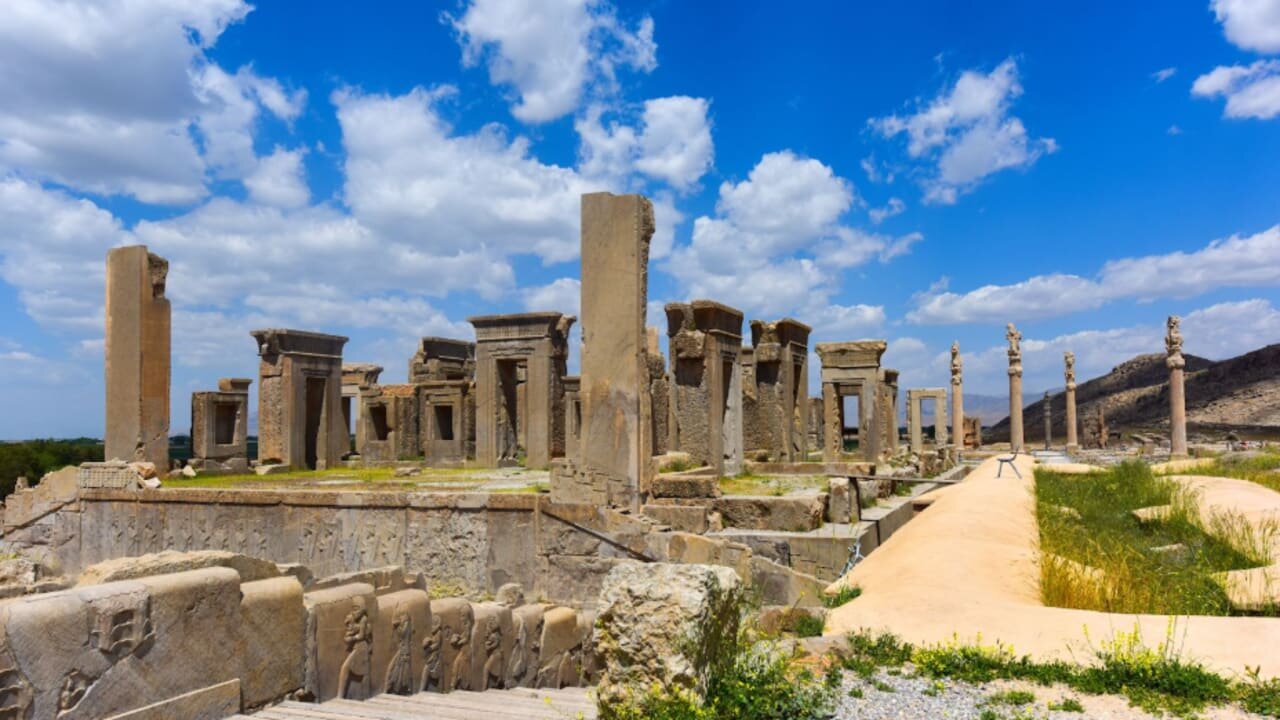
TEHRAN – A project has been launched to remove dangerous dead trees from UNESCO World Heritage Site Persepolis amid concerns for visitor safety and fire danger, local officials said.
Mohsen Najafi, head of the Marbdasht District Cultural Heritage Department, said the operation targeted uprooted and dead trees in the scenic area and entrance axis of the ancient site, locally known as Takht-e-Jamshid.
“The presence of old, dead trees along busy roads poses a significant and potentially dangerous problem,” Najafi said Wednesday. He blamed the deterioration on prolonged drought and increased salinity in groundwater sources, which weakened the trees and made them more likely to suddenly fall.
Najafi said many of the pine trees were originally planted decades ago because they had shallow root systems and were thought to be less likely to damage the underlying archaeological formations. However, these same characteristics make them more vulnerable in the current situation, leading to destabilization and uprooting.
He stressed that no healthy trees were cut down in the process. “All the trees collected had already been separated from their roots,” he said, adding that the work was carried out with the necessary permits and in coordination with state heritage authorities. A qualified contractor was selected to remove and transport the broken remains, which also affected the visual integrity of the site.
Najafi said there are legal constraints on efforts to restore removed trees. Heritage regulations prohibit the planting of new vegetation within the core and primary protection areas of World Heritage Sites, creating challenges for local authorities seeking to maintain green spaces while complying with conservation rules.
Persepolis, located in the Marvdasht province of Fars province in southern Iran, was founded by Darius the Great around 518 BC as the ceremonial capital of the Achaemenid Empire. This monumental complex, located approximately 60 km northeast of Shiraz, was partially destroyed by Alexander the Great in 330 BC. Sites such as the Apadana Palace and the Hall of the Hundred Pillars are considered to be among the most important archaeological sites in the world.
morning