
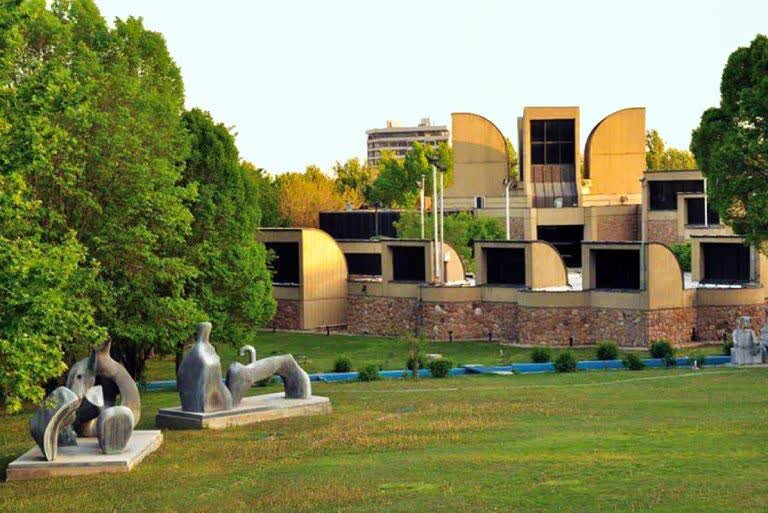
TEHRAN – In an open letter addressed to prominent museum directors around the world and the international museum community, the director of the Tehran Museum of Contemporary Art (TMoCA) reported that over the past 38 days, more than 100 historical artifacts and several museums and palace museums in Iran have suffered extensive damage due to the US and Israeli invasion of Iran, and called for global solidarity to protect humanity’s common heritage.
According to IRNA, in the letter, Reza Davilinejad expressed deep concern over the continued threats to Iran’s cultural and artistic treasures, stressing that these works are not only part of Iran’s national identity, but are the property of all humanity.
“Museums are not just places to store humanity’s unique treasures; they serve as mirrors that reflect humanity’s journey from prehistoric times to modern times. They tell the story of how civilizations were formed, laws were codified and principles of peaceful coexistence between peoples were established,” he said.
“But museums are also witnesses to another deplorable reality: wars have repeatedly destroyed great civilizations and their cultural and artistic achievements. The historical artifacts preserved in museums are the shared heritage of humanity who have survived attacks and crises,” he added.
Noting the historical role of museums in strengthening peace, dialogue and coexistence, Mr. Davilinejad urged colleagues around the world to prevent the recurrence of another tragedy in the world’s cultural history.
“Whether in the field of culture, art or science, museums strengthen the bonds between people by protecting these treasures. The purpose of museums is to create a platform for dialogue, reflection and mutual respect, thereby building a peaceful and beautiful world,” he said.
“Museums are not just custodians of objects, but guardians of human culture, art and knowledge. Those who promote war, on the contrary, are indifferent to the values of art, culture and human coexistence. They destroy bridges of connection between cultures and societies and oppose diversity and difference. In times of war, no place is safe from threats, not even museums,” he said.
“Iran’s museums, from ancient times to the present, symbolize the important and unique role of this land in the formation of human civilization and the enrichment of world cultural and artistic dialogue. They are proof of the unwavering resilience of Iranian civilization against threats and invasions,” Dabilinejad stressed.
“Unfortunately, in the past 38 days, Iran has once again been subjected to large-scale attacks. These attacks have caused serious and irreparable damage to more than 100 historical relics and many museums and palace museums across the country. These items are not only part of Iran’s national heritage, but also belong to the common heritage of humanity,” he denounced.
“Damage to these artefacts is an irreparable blow to the heritage of humanity. Museums and cultural heritage sites are built for peace, coexistence and dialogue across borders. The doors of museums are always open to the public, but in the cacophony of war, the gentle voices of culture and art are often lost,” he stressed.
At the end of his letter, Mr. Davilinejad emphasized the need to immediately notify the world museum community about the critical situation of Iran’s cultural heritage, and expressed the hope that the unity of museum professionals can serve as a barrier against the ravages of war.
“I appeal to you, my esteemed colleagues and custodians of our shared world heritage, to pay special attention to Iran’s civilizational and artistic treasures during these difficult times. With a united and resounding voice, let us prevent further damage to the precious human heritage embedded in this historic land,” he said.
“Furthermore, I ask you to help by informing and raising awareness of the global museum community about the critical situation of museums and cultural heritage in Iran. I strongly believe that the collective voice of the world’s museums is a cry for peace and coexistence. Only through the global solidarity of museum professionals can we protect our shared human heritage from war and destruction,” he concluded.
Tehran Museum of Contemporary Art is one of the largest museums in Iran. It houses a collection of more than 3,000 world-class European and American paintings, prints, drawings, photographs, and sculptures from the 19th and 20th centuries. TMoCA also has one of the most important collections of Iranian modern and contemporary art.
The architecture of the museum is also amazing. While the museum’s exterior design represents traditional Iranian style, the museum’s interior design resembles the modern-day Guggenheim Museum in New York.
The United States and Israel attacked Iran on February 28, martyring about 2,000 people, including Islamic revolutionary leader Seyyed Ali Khamenei, several officials, and military commanders, as well as numerous civilians, including women and children.
The invaders initially claimed the purpose of the attack was to thwart Iran’s nuclear program, but later revealed their true purpose. Israel’s maximalist goal is regime change in Iran, and the United States is seeking to seize the country’s oil and gas resources.
Therefore, in addition to some military targets, the United States and Israel have launched systematic attacks on civilian infrastructure, including homes, hospitals, refineries, power plants, schools, universities, artistic and cultural spaces, bookstores, museums, and ancient monuments in several cities, causing total or partial damage and injuring innocent people, in an attempt to force the country to surrender to unjust demands.
The attack prompted a swift response from the Islamic Revolutionary Guards Corps (IRGC), which has seen an intensification of missile and drone launches in recent days targeting Israel and several U.S. military bases in the region.
SS/